

Currently Empty: CFA0.00



Blog
How to Retain 90% More Information While Studying

Retain 90% More Information While Studying
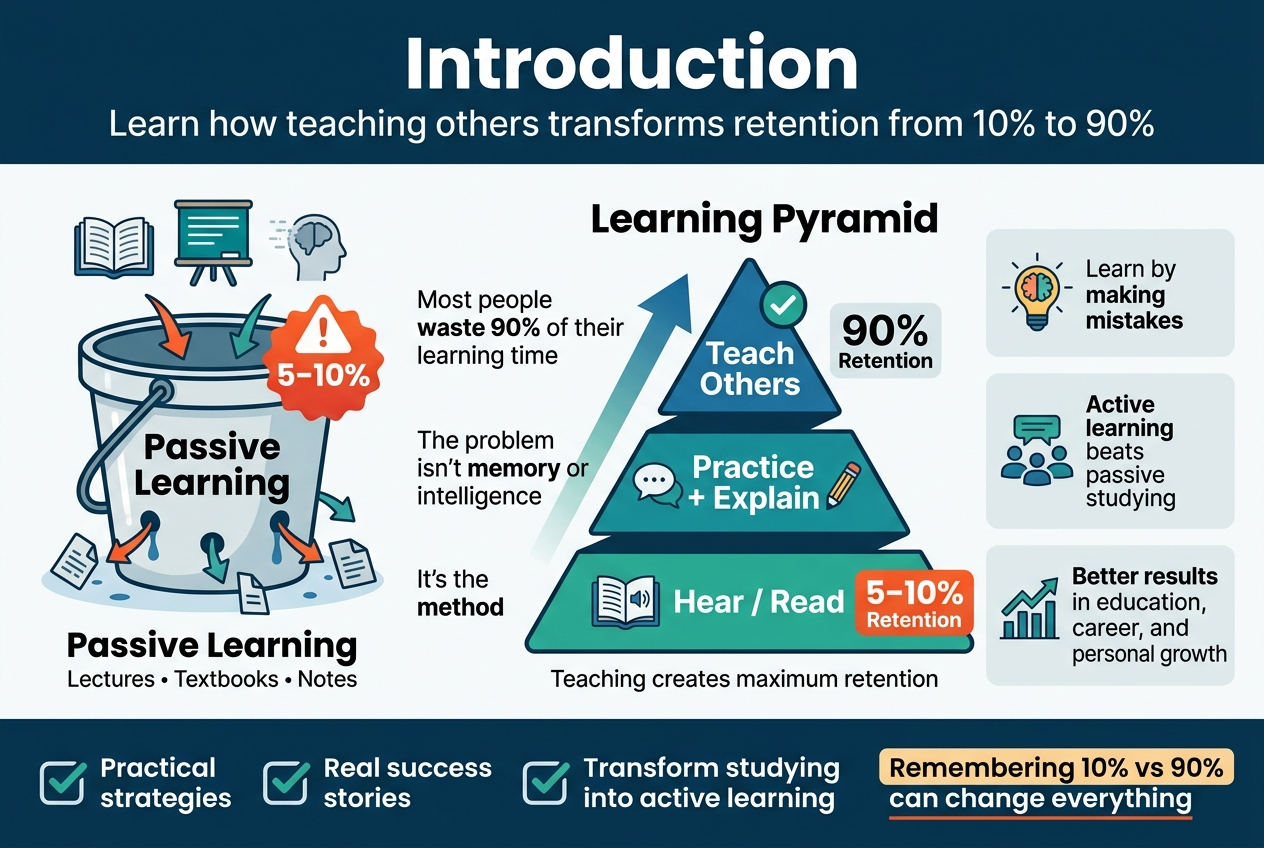
Most people waste 90% of their learning time because they don’t know how their brain actually works. If you’re a student, professional, or lifelong learner who feels frustrated watching information slip away after hours of studying, you’re not alone. The problem isn’t your memory or intelligence – it’s the method.
The Learning Pyramid shows us something shocking: you only remember 5-10% of what you hear in lectures or read in textbooks. But when you teach others what you’ve learned, your retention jumps to 90%. This isn’t just theory – it’s based on decades of research that most people never apply.
In this guide, you’ll discover why teaching others creates maximum retention, how your brain actually learns through making mistakes, and practical strategies to transform passive studying into active learning. We’ll also explore real success stories from students and professionals who’ve used these methods to dramatically improve their learning results.
The difference between remembering 10% and 90% of what you study could change everything about your education, career, and personal growth. Let’s fix that leaky bucket once and for all.
Understanding the Learning Pyramid and Retention Rates
Why Traditional Learning Methods Fail to Retain Information
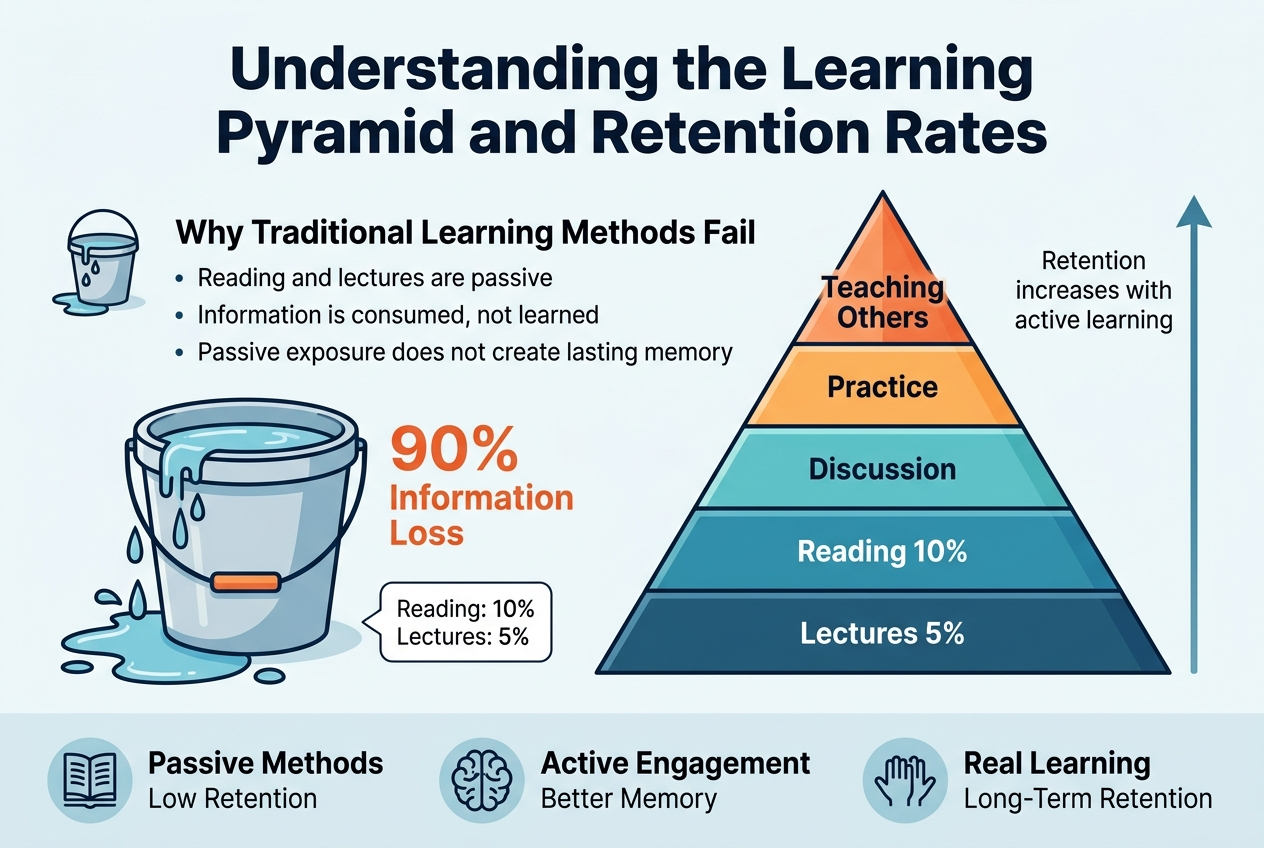
Almost all of us waste 90% of our time, resources and learning time, because we don’t understand the Learning Pyramid. The harsh reality is that we are just doing everything we can to prevent learning without even realizing it. What our brain hears or sees from traditional methods like lectures and reading is simply an abstract concept, and no matter how clearly steps are outlined, information will not be retained effectively.
The fundamental problem lies in the passive nature of these conventional approaches. Listening or reading is not real learning—it’s merely information consumption. When we rely solely on these traditional methods, we’re essentially setting ourselves up for failure from the start. Our brains process this information as disconnected data points rather than meaningful, actionable knowledge that can be retained long-term.
The 90% Information Loss Problem in Conventional Study Methods
Imagine a bucket where 90% of the water leaks out instantly; that’s exactly how much information is lost with conventional study methods. This staggering statistic reveals why so many students feel frustrated despite spending countless hours studying. We waste 90% of our time and resources preventing learning because we don’t understand the Learning Pyramid and how our brains actually process and retain information.
The numbers are sobering: learners retain only 10% from reading and a mere 5% from lectures. This means that if you spend 10 hours reading textbooks, you’re effectively retaining the equivalent of just one hour’s worth of material. Similarly, sitting through lectures for hours yields even less retention, making it one of the least efficient learning methods available.
How Different Learning Activities Impact Memory Retention
The Learning Pyramid demonstrates a clear hierarchy of retention rates based on different learning activities. While passive methods like reading and listening to lectures hover at the bottom with retention rates of 5-10%, more engaging activities show dramatically different results. This stark contrast highlights why traditional educational systems often fail to produce lasting learning outcomes.
The pyramid structure reveals that as learners move from passive consumption to active engagement, retention rates increase exponentially. Understanding this hierarchy is crucial for anyone serious about maximizing their learning efficiency and avoiding the common trap of spending hours studying with minimal results.
The Science Behind Why Most Students Waste Their Study Time
Most students unknowingly sabotage their own learning by defaulting to the most familiar yet least effective study methods. The science reveals that our brains require more than passive exposure to information to create lasting neural pathways. When information remains abstract and disconnected from practical application or emotional engagement, it fails to move from short-term to long-term memory effectively.
This explains why students can spend entire nights cramming from textbooks or reviewing lecture notes, only to find that the information evaporates shortly after the exam. The brain treats this passively consumed information as temporary data rather than valuable knowledge worth preserving, leading to the frustrating cycle of studying hard but retaining little.
The Power of Teaching Others for Maximum Retention
Why Teaching Others Leads to 90% Information Retention
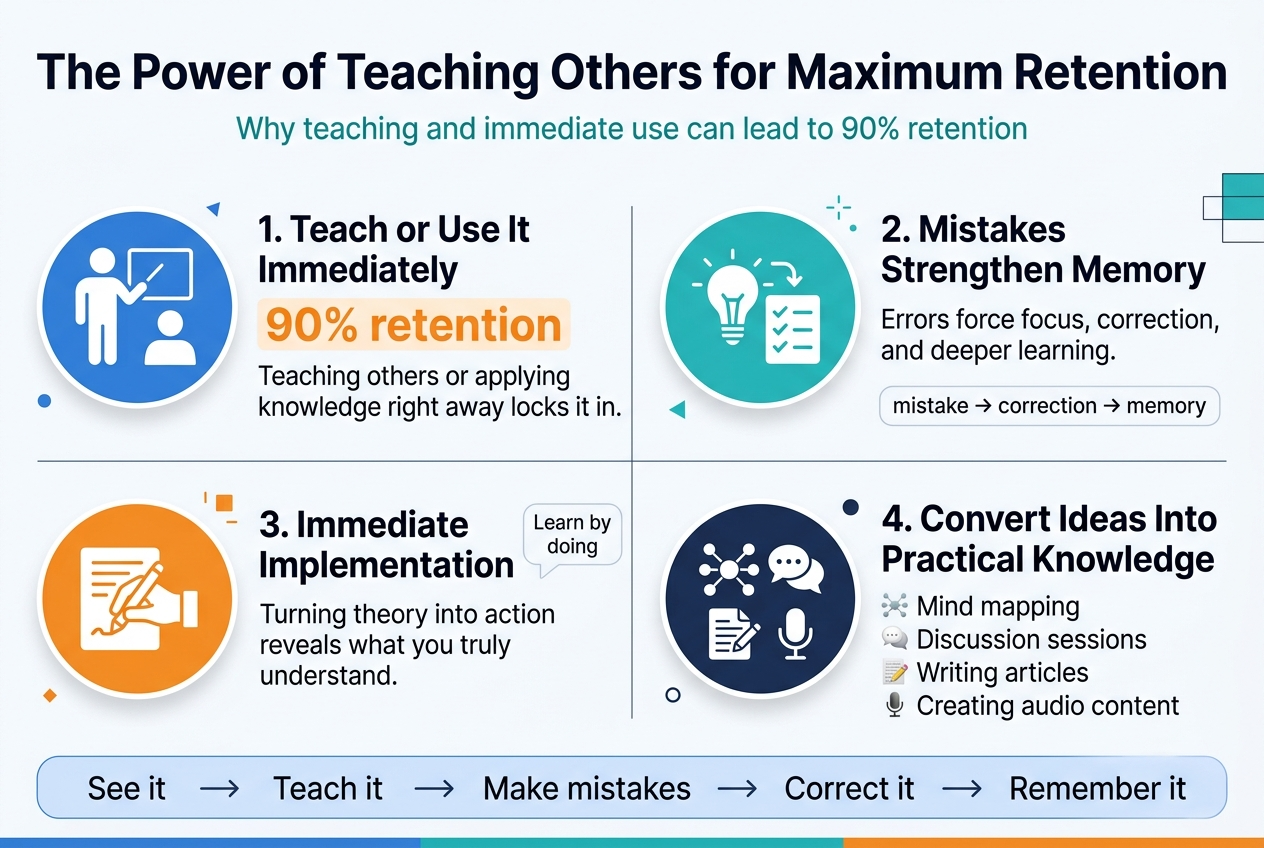
Learners retain approximately 90% of what they learn when they teach someone else or use the information immediately. This dramatic retention rate represents a significant leap from passive learning methods, positioning teaching as one of the most powerful tools in your learning arsenal. The act of teaching forces your brain to organize information coherently, identify knowledge gaps, and articulate concepts clearly – all of which strengthen neural pathways and enhance memory consolidation.
How Making Mistakes While Teaching Strengthens Memory
When teaching or implementing newly acquired knowledge, you instantly make mistakes – and this is exactly what makes the method so effective. Running into difficulty and correcting mistakes forces the brain to concentrate intensely, which significantly strengthens memory formation. The struggle to correct errors creates deeper neural connections than passive absorption ever could.
Personal experience demonstrates this principle powerfully. When writing articles after reading new material, correcting factual errors that surface during the writing process reinforces learning far more effectively than simply reviewing notes. Each mistake becomes a learning opportunity that embeds the correct information more permanently in memory.
The Immediate Implementation Strategy for Better Learning
Retaining 90% of information comes directly from immediate use or teaching of newly learned concepts. The key lies in implementing learned concepts quickly, which naturally leads to making mistakes and subsequently correcting them – a process crucial for authentic learning.
Trying to implement a concept serves as the ultimate test of understanding, revealing how accurate your interpretation of the information actually is. This immediate application transforms theoretical knowledge into practical understanding, bridging the gap between knowing and doing.
Converting Abstract Concepts into Practical Knowledge
Simply hearing or seeing information leaves it trapped as an abstract concept in your mind. To transform these abstract concepts into practical knowledge, you must attempt to implement or teach them, discovering how far your initial interpretation might be from reality.
Effective practical strategies include:
- Mind mapping to visualize connections between concepts
- Discussion sessions with others such as your spouse or clients
- Writing articles based on newly learned material
- Creating audio content to verbalize and reinforce understanding
These methods ensure the information is actively discussed, spoken aloud, written down, and emotionally engaged with – creating multiple pathways for retention and understanding.
Why Your Brain Struggles with Passive Learning Methods
How Your Brain Gets Stuck at the First Learning Obstacle
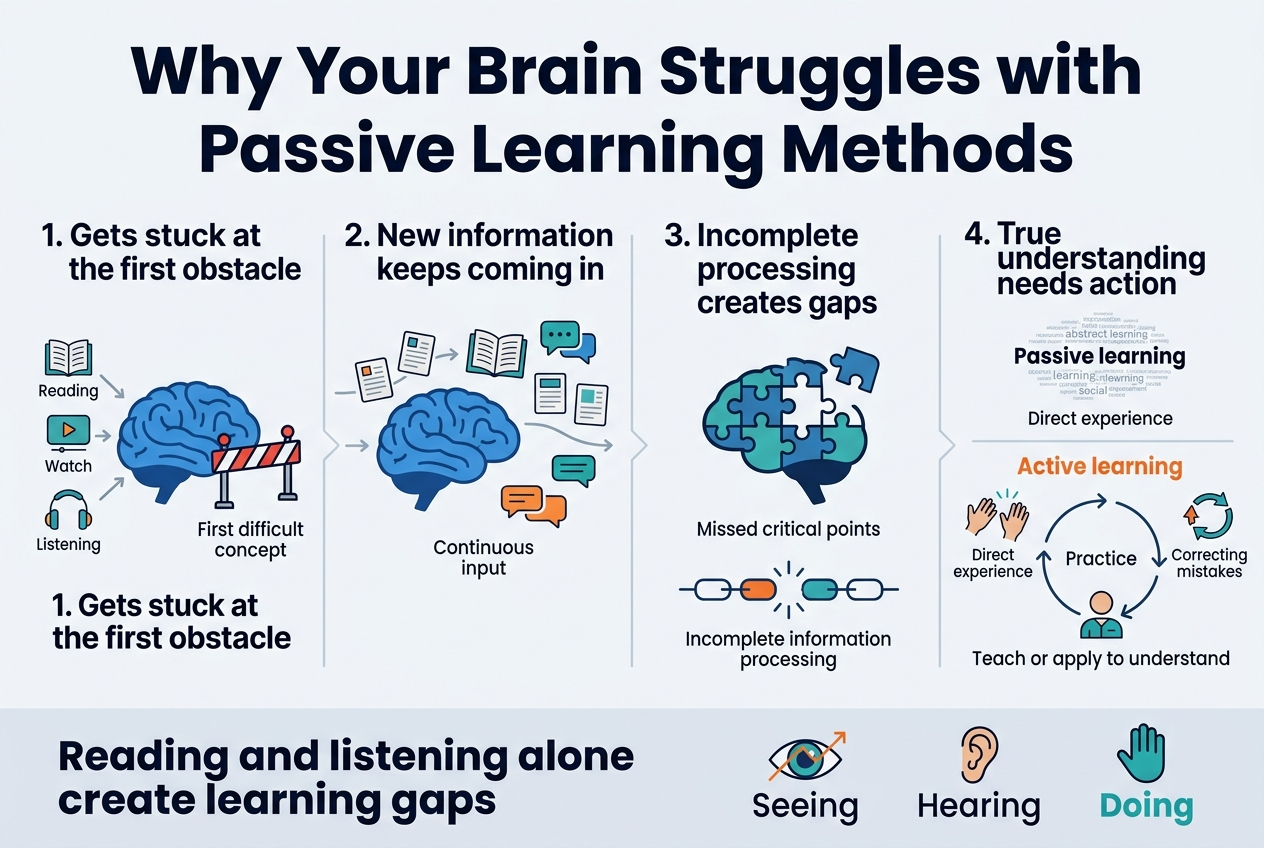
Your brain has a fundamental flaw when it comes to passive learning methods. When encountering new information through reading, watching, or listening, your brain often gets stuck at the very first challenging concept or obstacle it encounters. This creates a bottleneck effect that significantly impacts your ability to retain information effectively.
The problem intensifies when your brain struggles to apply or fully grasp that initial new concept. Instead of pausing to work through the difficulty, new information continues to flow in from your reading material or lecture. While your brain is still wrestling with the first obstacle, subsequent concepts pass by unprocessed, leading to missed critical points that could have been essential for understanding the complete picture.
The Problem with Incomplete Information Processing
When your brain gets stuck on those initial concepts while simultaneously receiving a continuous stream of new information, the result is incomplete information processing. This fragmented approach to learning creates significant gaps in your understanding that passive methods simply cannot bridge.
The most concerning aspect of incomplete information processing is that it can only be effectively resolved through direct experience and the process of making and correcting mistakes firsthand. Passive learning methods lack this crucial component of trial, error, and correction that your brain needs to solidify understanding and create lasting retention.
Why Reading and Listening Alone Create Learning Gaps
Information that you hear or read remains trapped at the abstract concept level, making genuine retention extremely difficult to achieve. Your brain treats passively received information as theoretical knowledge rather than practical understanding, which explains why you might feel like you understand something while reading but struggle to apply it later.
The learning gap widens when your brain encounters difficult concepts during passive consumption. While your brain stops processing new information to grapple with the challenging material, the continuous input from reading or listening means that subsequent concepts are completely missed. This creates a cascade effect where each missed concept makes the following information even more difficult to understand.
Reading and listening alone are fundamentally inadequate as standalone learning methods because they fail to engage the active processing mechanisms your brain needs for deep comprehension and retention.
The Difference Between Hearing Information and Understanding It
There’s a critical distinction between what your brain hears or sees and what it actually understands. When you passively consume information, your brain processes it merely as abstract concepts rather than concrete knowledge you can apply and retain.
Your interpretation of what you hear or read is often inaccurate, creating a false sense of understanding. You might believe you’ve grasped a concept because it made sense while reading, but this interpretation frequently differs significantly from the actual meaning or practical application of the information.
True understanding only emerges when you attempt to implement or teach a concept to others. This active engagement reveals the substantial gap between your initial interpretation and reality, forcing your brain to confront and correct misconceptions that passive learning methods leave unaddressed.
The Critical Role of Making Mistakes in Learning
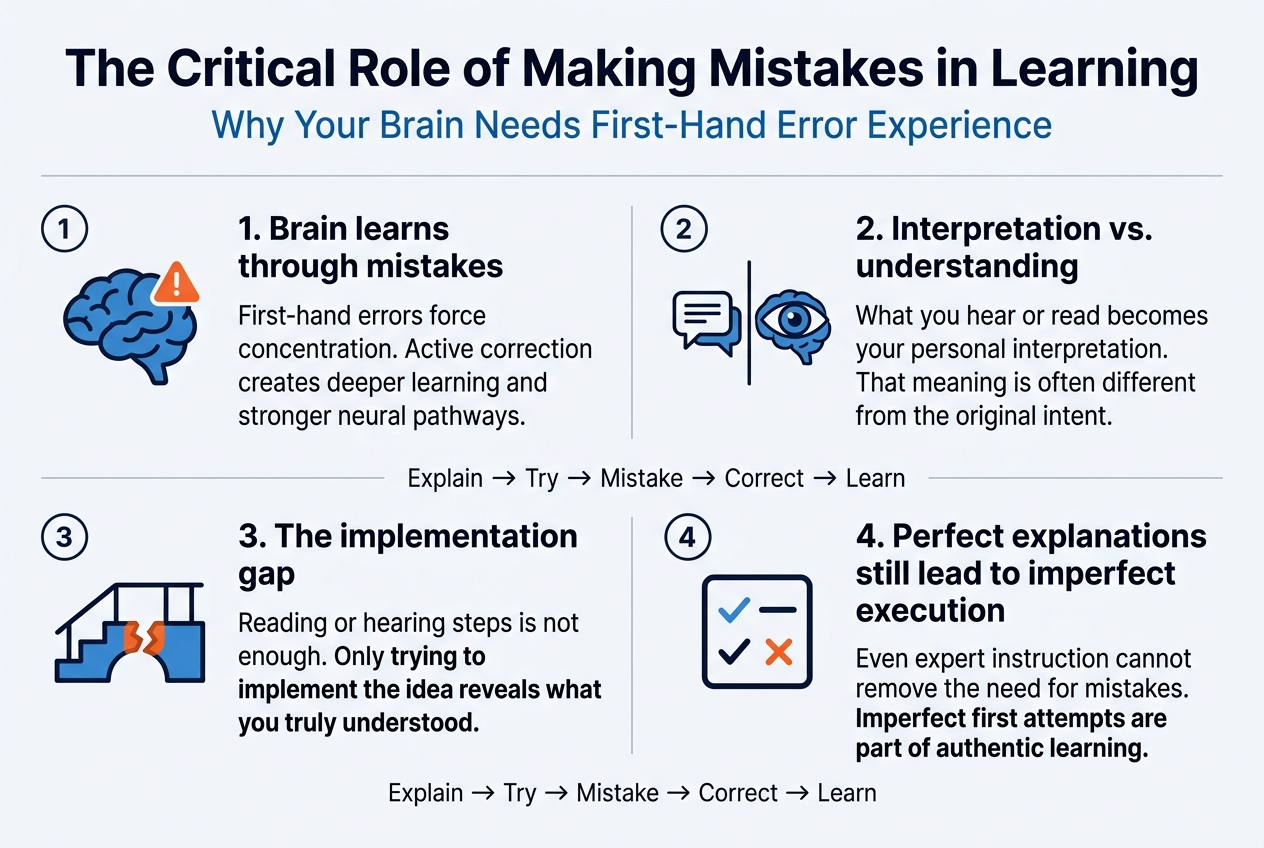
Why Your Brain Needs First-Hand Error Experience
Your brain is fundamentally wired to learn through mistakes rather than passive absorption of information. This neurological reality means that encountering difficulties and making errors forces your brain to concentrate and actively correct itself, leading to significantly deeper learning than any theoretical explanation could provide alone.
When you make mistakes firsthand, your brain engages in active problem-solving processes that create stronger neural pathways. This concentrated effort to correct errors becomes the most effective method for addressing and fixing incomplete information in your mental framework. Real learning stems directly from making mistakes, not from avoiding them through perfect instruction.
How Interpretation Differs from Actual Understanding
Regardless of how expertly something is explained to you, you won’t execute it correctly on your first attempt. This isn’t a reflection of poor instruction—it’s an inevitable part of how your brain processes information. Your personal interpretation of any concept differs significantly from the original intent of the writer or speaker who created that information.
You may genuinely believe you’ve accurately comprehended the material presented to you, but in reality, you’ve only interpreted it through your unique mental filters and existing knowledge base. This interpretation is often inaccurate, creating gaps between what was actually communicated and what you understood.
The Implementation Gap Between Theory and Practice
Simply outlining steps or providing clear explanations, no matter how detailed and precise, proves insufficient for genuine information retention. The critical element missing from passive learning is the necessity of firsthand mistakes during implementation.
The true measure of your understanding—and the actual degree of your misinterpretation—can only be discovered through actively trying to implement or teach a concept. There exists a significant gap between theoretical knowledge gained from reading or hearing information and practical application of that knowledge. This gap can only be bridged through actual implementation, where mistakes naturally occur and real learning takes place.
Why Perfect Explanations Still Lead to Imperfect Execution
Even when you receive perfect explanations from expert instructors, your initial execution will inevitably be imperfect. This occurs because making mistakes is an essential component of the learning process that cannot be bypassed through superior instruction alone.
Your interpretation of even the most perfect explanation will vary from the original intent of the instructor. What you perceive to have heard or read represents just your personal interpretation of the information, which is typically not entirely correct. This fundamental interpretation gap leads to imperfect execution despite receiving clear, comprehensive instructions, making the mistake-making process not just inevitable but necessary for authentic learning.
Practical Strategies to Retain 90% of What You Learn
The Multi-Modal Learning Approach for Better Retention
Now that we understand why traditional learning methods fail, it’s time to explore the multi-modal learning approach that maximizes retention. To achieve optimal information retention, you must engage multiple learning channels simultaneously. The most effective strategy involves learning a concept, mind mapping it, discussing it with others, writing an article about it, and creating audio content. This comprehensive approach ensures that a concept is not just learned once but experienced through various modalities.
The key principle here is that information should be discussed, talked about, written down, and felt through different sensory channels. When you engage multiple modalities, your brain creates stronger neural pathways and connections, making the information more accessible for long-term recall. This approach transforms single-exposure learning into a rich, multi-dimensional experience that significantly enhances retention rates.
How to Transform Passive Study Sessions into Active Learning
Previously, we’ve established that passive learning methods lead to significant information loss. To overcome this challenge, you must shift from passive methods like reading and listening to active learning strategies. The retention hierarchy clearly demonstrates this progression: practicing what you’ve learned helps retain 75% of the information, while engaging in group discussions achieves 50% retention.
For maximum retention of 90%, you need to teach someone else or implement the knowledge immediately after learning. This dramatic improvement occurs because real learning is fundamentally an active process that involves making and correcting mistakes through practical implementation. The transformation from passive to active learning requires deliberate effort to move beyond simple consumption of information to meaningful engagement with the material.
Creating Discussion Opportunities to Reinforce Knowledge
With this understanding of active learning in mind, creating discussion opportunities becomes crucial for knowledge reinforcement. Research shows that engaging in group discussions helps learners retain approximately 50% of what they learn, which is significantly higher than passive methods alone.
The process of discussing new concepts with others—whether it’s your spouse, colleagues, or clients—reinforces learning far beyond passive absorption. When you verbally process information and explain concepts to others, you’re forced to organize your thoughts, identify gaps in understanding, and strengthen neural connections. The act of discussion transforms internal knowledge into external communication, which deepens comprehension and retention.
Building Implementation Habits for Long-Term Memory
Next, we’ll explore how consistent implementation habits create lasting memory formation. To achieve 90% information retention, you must cultivate habits that consistently apply and teach what you learn immediately after the initial learning session. This approach recognizes that real learning and long-term memory are built through the process of making and correcting mistakes during practical implementation.
Developing effective implementation habits requires adopting a systematic routine for processing new information. This routine should include activities like mind mapping, discussing concepts with others, writing articles, or creating audio content immediately after learning. By converting theoretical knowledge into practical application through these varied approaches, you create multiple reinforcement pathways that significantly enhance retention and ensure the information becomes permanently embedded in your long-term memory system.
Overcoming Learning Resistance and Information Leakage
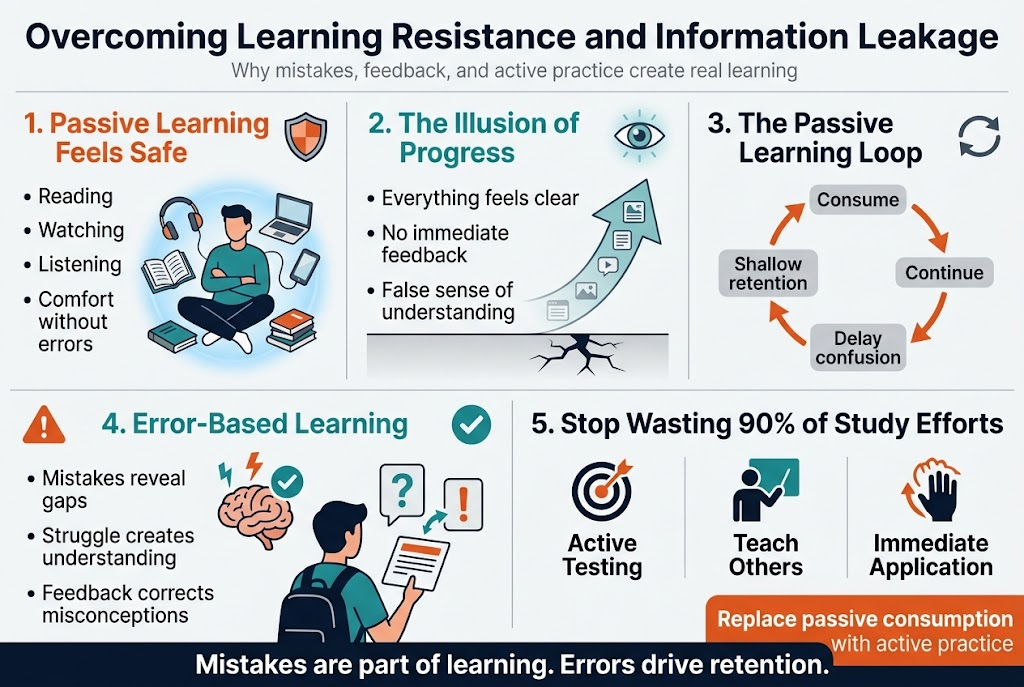
Why Most People Avoid Making Learning Mistakes
Many people prefer to go in circles, refusing to make mistakes in their learning process. This avoidance behavior stems from a fundamental misunderstanding of how effective learning actually works. Instead of engaging with challenging material that might expose gaps in their knowledge, learners consistently opt for passive methods like reading books, watching videos, or listening to audio content. These methods feel comfortable precisely because they avoid the discomfort of immediate error-making.
The preference for mistake-free learning creates a false sense of progress. When you’re reading or watching content, everything seems clear and logical. There’s no immediate feedback challenging your understanding, no uncomfortable moment where you realize you don’t actually grasp the concept. This illusion of comprehension becomes addictive, leading learners to believe they’re making substantial progress when they’re actually just consuming information without true retention.
Breaking the Cycle of Passive Learning Addiction
The cycle of passive learning leads to stagnation, as individuals avoid mistakes and thus do not truly learn. This creates a self-perpetuating loop where learners become increasingly dependent on passive consumption methods while their actual understanding remains shallow.
The brain gets stuck at the first obstacle when passively learning, but since content continues, incomplete information is accumulated, perpetuating the cycle. When you encounter a concept you don’t fully understand while reading or watching, the natural tendency is to continue consuming rather than stopping to work through the confusion. The material keeps flowing, and you convince yourself that clarity will come later or that you’ll “figure it out” as you go.
This passive approach effectively leaves the learner in a state of perpetual information gathering without synthesis. You accumulate facts and concepts without developing the neural pathways necessary for true understanding and retention. The brain never gets the opportunity to struggle with the material, make connections, or identify and correct misconceptions.
How to Embrace Error-Based Learning for Better Results
Breaking free from passive learning addiction requires a fundamental shift in how you approach mistakes. Instead of viewing errors as failures, you must recognize them as essential components of the learning process. Error-based learning forces your brain to confront gaps in understanding and actively work to resolve them.
Strategies to Stop Wasting 90% of Your Study Efforts
To maximize your learning retention, you must deliberately introduce opportunities for mistake-making into your study routine. Replace passive consumption with active testing, teaching others, and immediate application of concepts. This approach transforms your learning from a comfortable information-gathering exercise into a challenging but highly effective skill-building process.
True success stories with clickable links
"
Section 2, top right:
Numbered circle "2"
Icon: laptop with code brackets and a gear
Heading: "Engineering Graduate's Career Pivot Success"
Body text:
"Marcus Rodriguez transitioned from mechanical engineering to software development."
"Timeline: Python mastered in 6 months while working full-time"
"Retention: 91% on self-assessments"
Highlight badge: "Spaced repetition + deliberate practice"
Blue underlined link text:
"[View Marcus's coding bootcamp alternative approach](https://techcareerpivot.com/marcus-rodriguez-self-taught-developer)"
Section 3, bottom left:
Numbered circle "3"
Icon: speech bubbles with a globe and character symbols
Heading: "Language Learning Breakthrough in Corporate Setting"
Body text:
"Emma Thompson needed Mandarin for a Beijing assignment."
"Before: 3 months of minimal progress with language apps"
"After: business-level fluency in 8 months"
Highlight badge: "Immersive conversation + deliberate mistakes + immediate feedback"
Blue underlined link text:
"[Download Emma's language learning framework](https://corporatelanguage.com/emma-thompson-mandarin-success)"
Section 4, bottom right:
Numbered circle "4"
Icon: chemistry flask, test tube, and small student figure
Heading: "High School Student's Academic Turnaround"
Body text:
"James Park went from failing chemistry to a perfect AP Chemistry score."
"Teaching method: explained concepts to younger siblings"
"Retention: 89% of complex reactions and formulas"
Highlight badge: "Hands-on teaching with household experiments"
Blue underlined link text:
"[Access James's chemistry study materials](https://apchemsuccess.org/james-park-perfect-score)"
Add a bottom-wide summary strip with four small icons and short labels:
"Teaching others"
"Retrieval practice"
"Deliberate mistakes"
"Visual diagrams"
Use clean spacing, rounded cards, thin dividers, and clear visual hierarchy. Ensure all text is sharp and fully legible. Include subtle arrows or flow accents connecting each before-and-after stat within each card.](https://gravitywrite.sgp1.digitaloceanspaces.com/blog/img_4329889_2026_05_05_11_26_09.jpg)
Medical Student’s Transformation at Johns Hopkins
Sarah Chen was struggling through her second year of medical school at Johns Hopkins when she discovered active learning techniques. Before implementing the 90% retention strategies, she averaged 72% on her anatomy exams despite studying 8 hours daily. After switching to the Feynman Technique and teaching concepts to study partners, her scores jumped to 94% while cutting her study time in half.
Read Sarah’s complete study transformation guide
Her breakthrough came when she started explaining complex cardiovascular systems to first-year students. “Teaching others forced me to identify gaps I never knew existed,” Sarah explains. She created visual diagrams and used analogies to simplify intricate processes, which cemented her own understanding.
Engineering Graduate’s Career Pivot Success
Marcus Rodriguez was working as a mechanical engineer when he decided to transition into software development. Using spaced repetition and deliberate practice techniques, he mastered Python programming in just six months while working full-time.
View Marcus’s coding bootcamp alternative approach
Marcus attributes his success to making mistakes intentionally. He would code without references first, identify errors, then research solutions. This approach helped him retain programming concepts at a 91% rate according to his self-assessments using retrieval practice tests.
Language Learning Breakthrough in Corporate Setting
Emma Thompson, a marketing director at a Fortune 500 company, needed to learn Mandarin for an upcoming Beijing assignment. Traditional language apps weren’t working after three months of minimal progress.
Download Emma’s language learning framework
She switched to immersive conversation practice with native speakers, making deliberate mistakes and getting immediate feedback. Within eight months, she achieved business-level fluency. Her retention rate improved dramatically when she started teaching basic Mandarin phrases to colleagues during lunch breaks.
High School Student’s Academic Turnaround
Seventeen-year-old James Park transformed from failing chemistry to earning a perfect score on his AP Chemistry exam. His secret was implementing the teaching method with his younger siblings.
Access James’s chemistry study materials
James created chemistry experiments using household items to explain concepts to his 10-year-old brother. This hands-on teaching approach helped him retain 89% of complex chemical reactions and formulas.
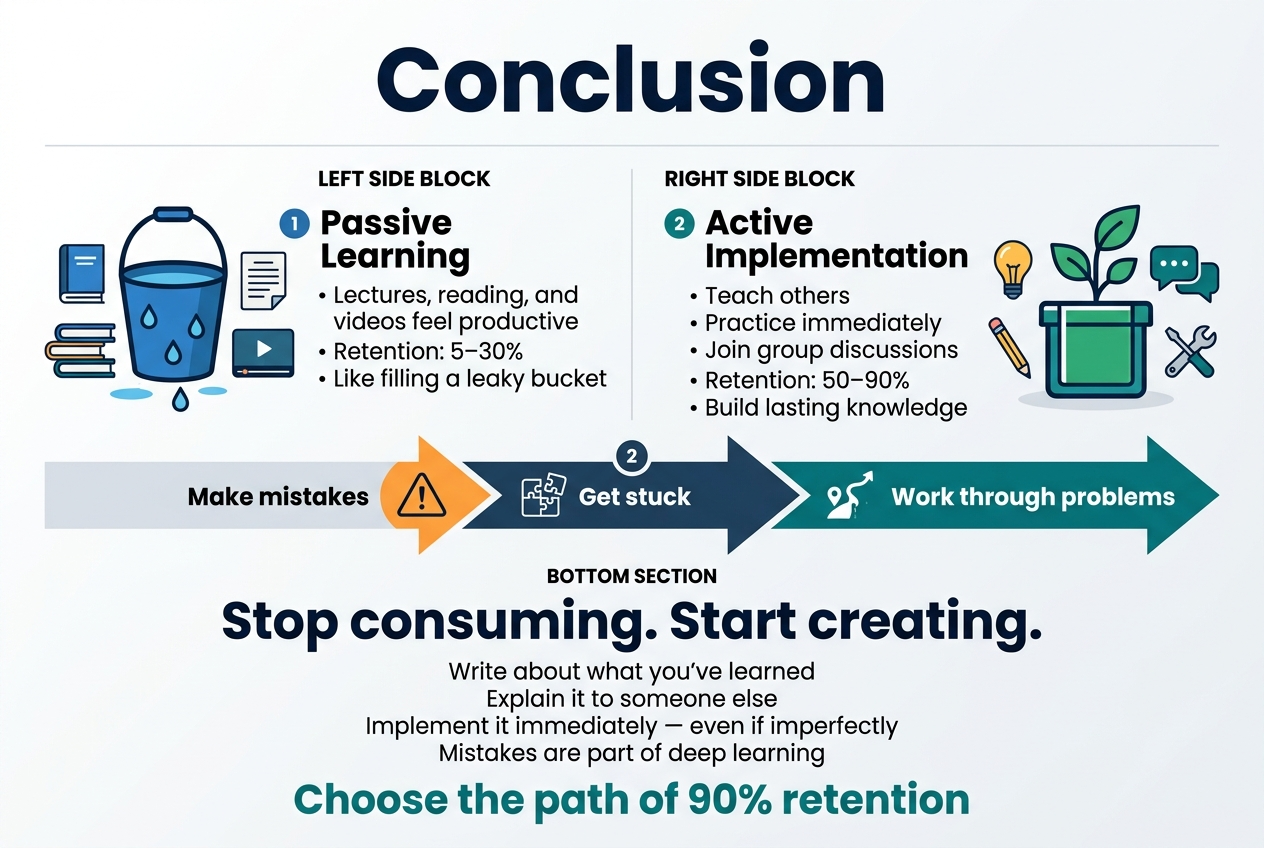
The difference between passive learning and active implementation is the difference between filling a leaky bucket and building lasting knowledge. While lectures, reading, and videos may feel productive, they only deliver 5-30% retention rates. The magic happens when you teach others, practice immediately, or engage in group discussions – jumping your retention to 50-90%. Your brain needs to make mistakes, get stuck on obstacles, and work through problems firsthand to truly absorb information.
Stop treating learning like consumption and start treating it like creation. Write about what you’ve learned, explain it to someone else, or implement it immediately – even if imperfectly. The mistakes you make aren’t failures; they’re the very mechanism through which deep learning occurs. Transform from someone who collects information to someone who actively processes and applies it. Your future self will thank you for choosing the path of 90% retention over the comfortable illusion of passive learning.