
Currently Empty: CFA0.00



Blog
Why 90% of People Never Finish Online Courses And How to Fix It

Why 90% of People Never Finish Online Courses
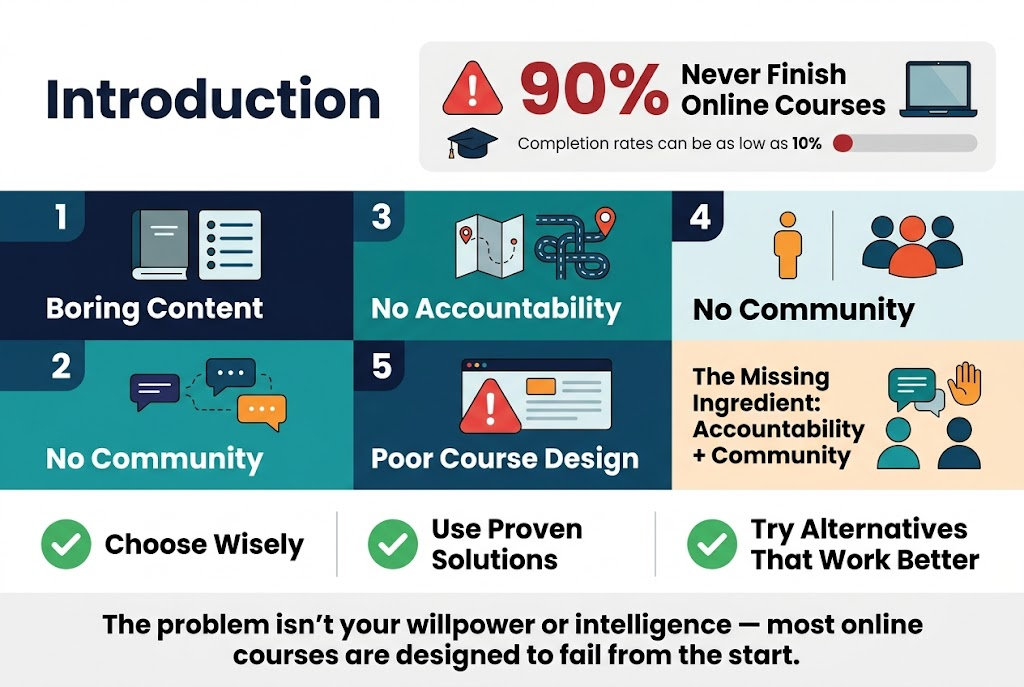
Most people who start online courses never finish them. You’re not alone if you’ve abandoned a class after the first few lessons—research shows that 90% of people never finish online courses they begin.
This massive dropout rate affects everyone from busy professionals trying to learn new skills to students taking courses from top universities. Even platforms like Coursera, Udemy, and Skillshare see extremely low completion rates.
If you’ve ever struggled with:
…then this guide is for you.
Millions of learners enroll in programs from Google Career Certificates, free AI courses, coding bootcamps, freelancing academies, and business masterclasses every year—but most never reach the finish line.
Why?
Because most online learning platforms are optimized for selling courses, not helping students complete them.
Many students start with excitement after watching productivity videos on YouTube Learning or downloading apps like Coursera App and Udemy Mobile App, but motivation fades quickly without accountability.
The real issues usually include:
-
lack of structure,
-
boring passive video content,
-
zero implementation guidance,
-
no community support,
-
and overwhelming information overload.
That’s why searches for:
…have exploded in recent years.
Even learners taking courses from elite universities through Coursera’s university programs often struggle to stay engaged.
Some students turn to communities like Reddit LearnProgramming discussions looking for advice because they feel isolated and stuck halfway through expensive programs.
Others search for alternatives like:
because they realize information alone does not create transformation.
Action does.
And action becomes easier when learning includes:
-
accountability,
-
mentorship,
-
implementation,
-
deadlines,
-
peer support,
-
and real-world projects.
That’s why modern learners are increasingly choosing:
instead of traditional passive video courses.
The problem isn’t that you lack intelligence or willpower.
The problem is that most online courses are designed to deliver content—not results.
The Shocking Reality Behind Online Course Failure Rates

Why 93% of students abandon their online courses
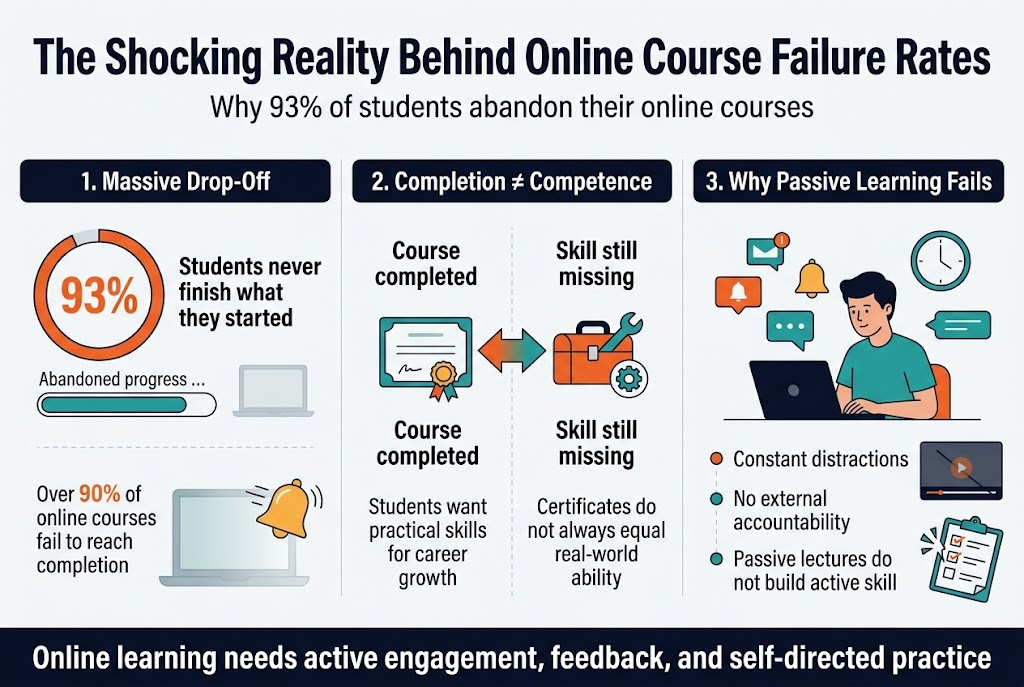
The statistics surrounding online course completion rates paint a stark picture that few in the education industry want to acknowledge. Over 90% of online courses fail to reach completion, with some authoritative sources reporting that 93% of students never finish what they started. This isn’t just a problem plaguing lesser-known platforms—even reputable educational giants like Coursera report incompletion rates hovering around 90% for many of their offerings.
These staggering numbers reveal a fundamental disconnect between how online education is delivered and how modern learners actually engage with digital content. The high incompletion rates stem from a deeper issue: people are struggling to maintain focus and follow through on commitments in today’s increasingly distracted world. The constant barrage of notifications, competing priorities, and the absence of external accountability creates an environment where good intentions quickly dissolve into abandoned course dashboards.
The difference between course completion and actual skill development
Even more concerning than the completion statistics is the gap between finishing a course and developing genuine competency. Students often seek online classes specifically to acquire practical skills that will advance their careers, highlighting a clear desire for results and applicable knowledge rather than just information consumption.
This disconnect becomes particularly evident when learners who do complete courses find themselves unable to apply what they’ve supposedly learned in real-world situations. The focus on completion metrics rather than skill mastery has created a system that prioritizes certificates over competence, leaving students with a false sense of accomplishment but lacking the practical abilities they originally sought.
Why 90% of People Never Finish Online Courses:
How passive learning models fail in digital environments
The traditional educational approach of watching lectures, memorizing content, and taking standardized tests simply does not translate effectively to online environments. This passive learning model, which may have worked in physical classrooms with direct instructor oversight and peer interaction, crumbles in the isolated digital space where students lack immediate feedback and social reinforcement.
Digital environments require active engagement and self-directed learning strategies that most traditional course structures fail to provide. Without the natural accountability of in-person classes and the immediate clarification opportunities that come with face-to-face interaction, students quickly lose momentum and struggle to maintain the discipline required for meaningful skill development.
Five Critical Reasons Students Quit Online Courses
Courses lack engagement and excitement factors
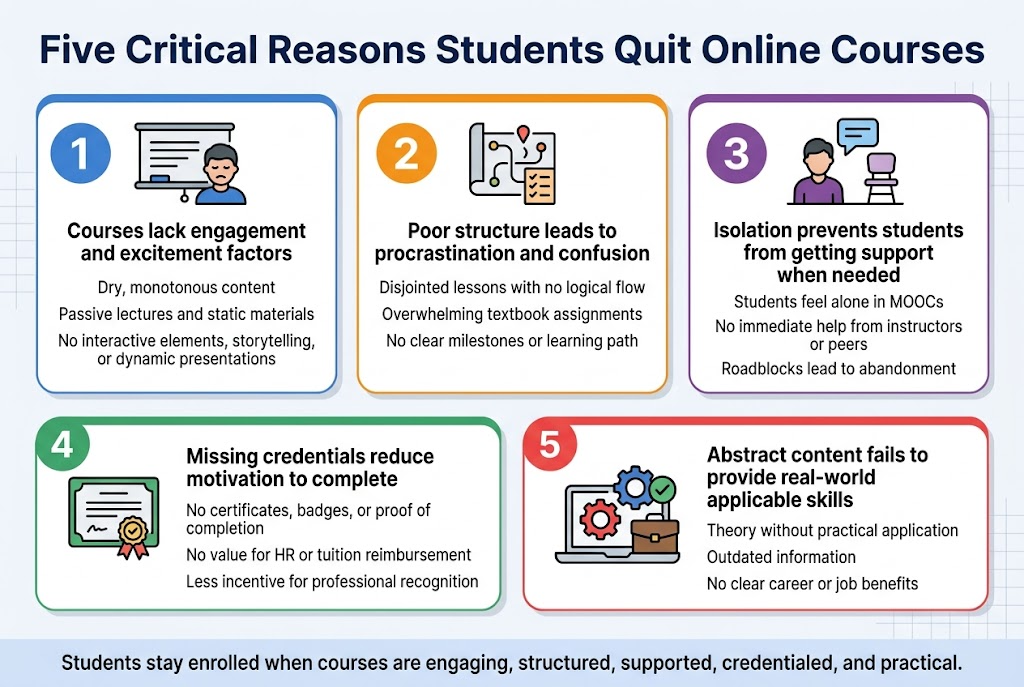
Many online courses fail to capture and maintain student interest from the very beginning. The fundamental issue lies in the delivery method – courses often present information in a dry, monotonous format that fails to stimulate learners emotionally or intellectually. This becomes particularly problematic when students are tackling subjects they feel they “should” learn rather than genuinely want to explore.
Without engaging elements like interactive components, compelling storytelling, or dynamic presentations, students quickly lose motivation. The passive nature of consuming pre-recorded lectures or reading through static materials creates a disconnect between the learner and the content, making it easy to postpone or abandon the learning journey altogether.
Poor structure leads to procrastination and confusion
Structural deficiencies represent one of the most significant barriers to course completion. When courses consist of disjointed recordings that lack logical flow or coherent progression, students struggle to understand how individual lessons connect to form a comprehensive learning experience.
Extensive textbook assignments compound this problem by overwhelming learners with dense material that feels disconnected from practical application. Without clear milestones, organized modules, or a well-defined learning path, students find themselves procrastinating because they cannot envision their progress or understand what comes next. This confusion creates a cycle where uncertainty breeds delay, and delay reinforces the feeling that the course is too difficult or time-consuming to complete.
Why 90% of People Never Finish Online Courses:
Isolation prevents students from getting support when needed
The solitary nature of online learning creates a significant psychological barrier to completion. In large-scale online courses, particularly MOOCs (Massive Open Online Courses), students often feel completely alone in their learning journey. This isolation becomes particularly damaging when learners encounter difficult concepts or technical challenges that require clarification or support.
Unlike traditional classroom settings where immediate help is available from instructors and peers, online learners frequently have no accessible support system. When students hit roadblocks and cannot find help, they often choose to abandon the course rather than struggle through confusion independently. The absence of human connection and community support removes the accountability and encouragement that many people need to persist through challenging material.
Missing credentials reduce motivation to complete
The lack of official credentials or meaningful proof of completion significantly undermines student motivation. Learners invest considerable time and effort into coursework, and they naturally desire tangible evidence of their achievements that can benefit their professional lives.
Without certificates, badges, or other forms of recognition that carry weight with HR departments or can be used for tuition reimbursement, students question the value of completing the entire course. This credential gap is particularly demotivating for working professionals who need to justify their learning investments to employers or who seek to make positive impressions in their professional networks. When the completion effort cannot be leveraged for career advancement or professional recognition, the incentive to finish diminishes dramatically.
Abstract content fails to provide real-world applicable skills
Perhaps the most critical failure point is the disconnect between course content and practical application. Many online courses present information in abstract or theoretical terms without demonstrating how students can immediately apply what they’re learning in real-world situations.
This problem is exacerbated when courses contain outdated information that no longer reflects current industry practices or technological standards. Students quickly recognize when the skills being taught won’t advance their careers or solve actual problems they face in their professional lives. Without clear connections between the learning material and tangible career benefits, students lose motivation to continue investing time in content that feels irrelevant to their immediate needs and long-term professional goals.
The Missing Ingredient: Accountability and Community
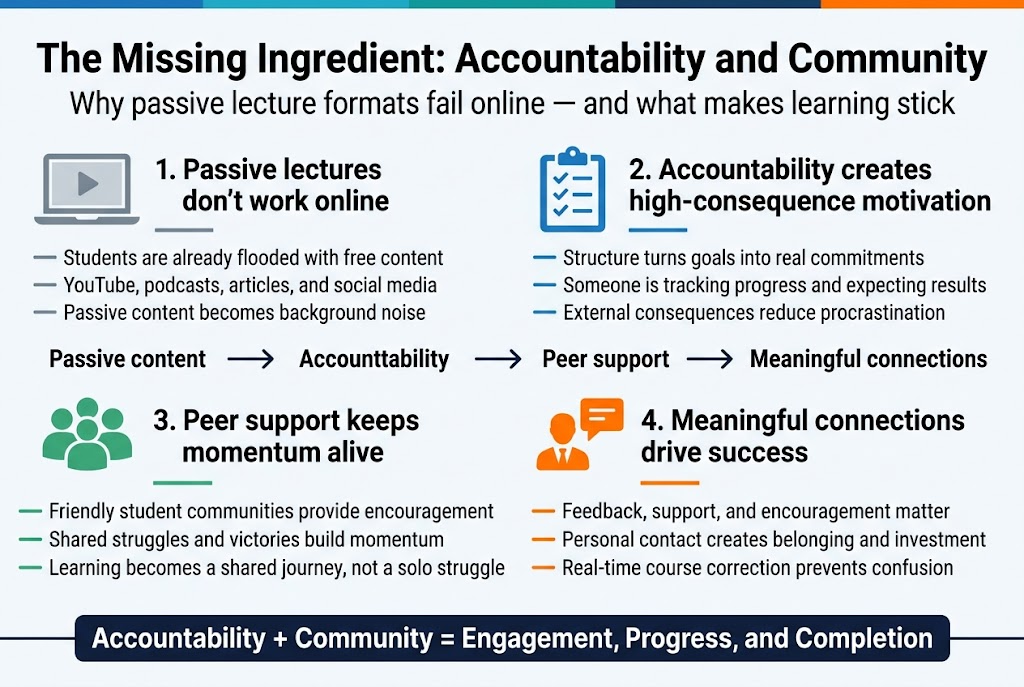
Why traditional lecture formats don’t work online
Traditional passive learning models and lecture formats often fail online for several critical reasons that course creators frequently overlook. Even brilliant academic minds may not translate into engaging lecturers in the digital environment, where students lack the physical presence and social dynamics of a classroom. The fundamental issue lies in the disconnect between how we naturally learn and how most online courses are structured.
When students are already inundated with free information from countless sources—YouTube videos, podcasts, articles, and social media content—another passive lecture simply becomes background noise. The digital format strips away the natural accountability mechanisms that exist in physical classrooms, leaving students to rely solely on their own motivation and discipline.
How accountability creates high-consequence motivation

Accountability serves as the cornerstone of successful learning, creating high-consequence motivation that helps students overcome inertia and procrastination in our increasingly distracted world. This principle becomes even more critical in online environments where students face constant digital distractions and competing priorities.
Students in traditional education, particularly at prestigious institutions like Ivy League schools, actively seek accountability and structure from their curriculum and teachers who are genuinely invested in their success. This external framework creates consequences for inaction and rewards for progress, fundamentally changing how students approach their learning journey.
The power of accountability lies in its ability to transform abstract goals into concrete commitments with real stakes attached. When students know someone is tracking their progress and expecting results, they’re far more likely to push through challenging moments and maintain consistent effort.
The power of peer support in maintaining momentum
Active and friendly student communities provide essential peer support that becomes the lifeline for maintaining momentum throughout challenging course material. Unlike isolated learning experiences, peer connections create a network of mutual encouragement and shared accountability that keeps students engaged even when motivation wanes.
Fellow learners offer unique perspectives, share struggles and victories, and provide the social proof that others are successfully navigating similar challenges. This peer support system becomes particularly valuable during difficult phases of learning when students might otherwise consider quitting.
The collaborative environment fostered by strong peer connections transforms learning from a solitary struggle into a shared journey, where students can draw strength from others’ experiences and contribute their own insights to the community.
Building meaningful connections with instructors and fellow students
Meaningful connections with instructors and fellow students, offering feedback, support, and encouragement, significantly impact remote learning success in ways that go far beyond simple information transfer. Personal contact with instructors creates a human element that transforms the learning experience from consuming content to engaging in genuine educational relationships.
These connections provide multiple touchpoints for learning reinforcement, including personalized feedback that addresses individual challenges and strengths. When instructors and peers offer targeted support and encouragement, students develop a sense of belonging and investment in their learning journey that passive course consumption simply cannot replicate.
The feedback loop created through meaningful connections helps students course-correct in real-time, address confusion before it compounds, and celebrate progress in ways that maintain long-term motivation and engagement throughout the entire learning process.
Proven Solutions to Dramatically Improve Completion Rates
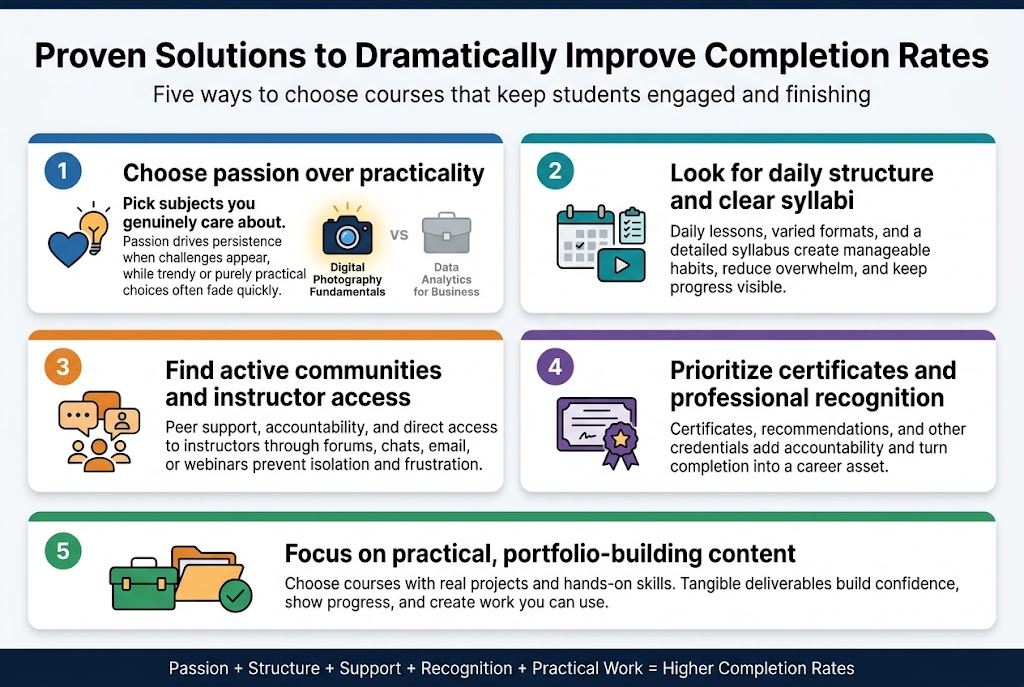
Choose passion-driven subjects over practical-sounding topics
To improve completion rates, students should choose subjects they are genuinely excited about, as passion is a stronger motivator than practicality. When you select courses based solely on what seems professionally beneficial or trendy, you’re setting yourself up for failure. Passion fuels persistence through challenging moments and difficult concepts, while purely practical choices often lead to abandonment when the initial motivation wanes.
Consider the difference between enrolling in “Data Analytics for Business” because it sounds career-enhancing versus choosing “Digital Photography Fundamentals” because you’ve always been fascinated by visual storytelling. The latter choice, driven by genuine interest, creates intrinsic motivation that sustains you through the learning journey.
Select courses with daily structured lessons and clear syllabi
Now that we’ve covered the importance of passion, let’s examine the structural elements that support completion. Opt for classes with daily structured lessons, varying lesson types including videos, interactive exercises, and projects, along with clear, detailed syllabi to stay on track. This structured approach prevents overwhelm and creates manageable daily habits.
Courses with diverse lesson formats keep engagement high by appealing to different learning styles and preventing monotony. A well-designed syllabus acts as your roadmap, showing exactly what you’ll learn and when, which helps maintain momentum and provides clear progress markers.
Find programs with active student communities and instructor access
With this in mind, next we’ll see how community support transforms the learning experience. Seek out programs that offer active and friendly student communities, along with direct contact with instructors through forums, live chats, email, or webinars. The isolation of online learning is one of the primary reasons students quit, making community connection crucial for success.
Active student communities provide peer support, accountability, and opportunities to discuss challenging concepts with fellow learners. Direct instructor access ensures you can get clarification on difficult topics before frustration leads to abandonment.
Prioritize courses offering certificates and professional recognition
Previously, I’ve emphasized internal motivators, but external validation also plays a critical role. Prioritize courses that provide certificates of completion, professional recognition, or even personalized letters of recommendation to validate learning and aid career advancement. These tangible outcomes create additional accountability and provide concrete evidence of your investment in learning.
Professional recognition transforms your course completion from a personal achievement into a career asset, making the effort feel more worthwhile and increasing your commitment to finishing.
Focus on practical, portfolio-building content over theory
Focus on programs that teach practical, applicable skills and help build a portfolio of work and projects, which are highly valued by future employers and clients. Theory-heavy courses often feel abstract and disconnected from real-world application, leading to disengagement. Practical courses that result in portfolio pieces provide immediate value and create a sense of tangible progress.
When you can see your skills developing through actual projects and deliverables, you’re more likely to persist through challenges and complete the entire program.
Alternative Approaches That Actually Work
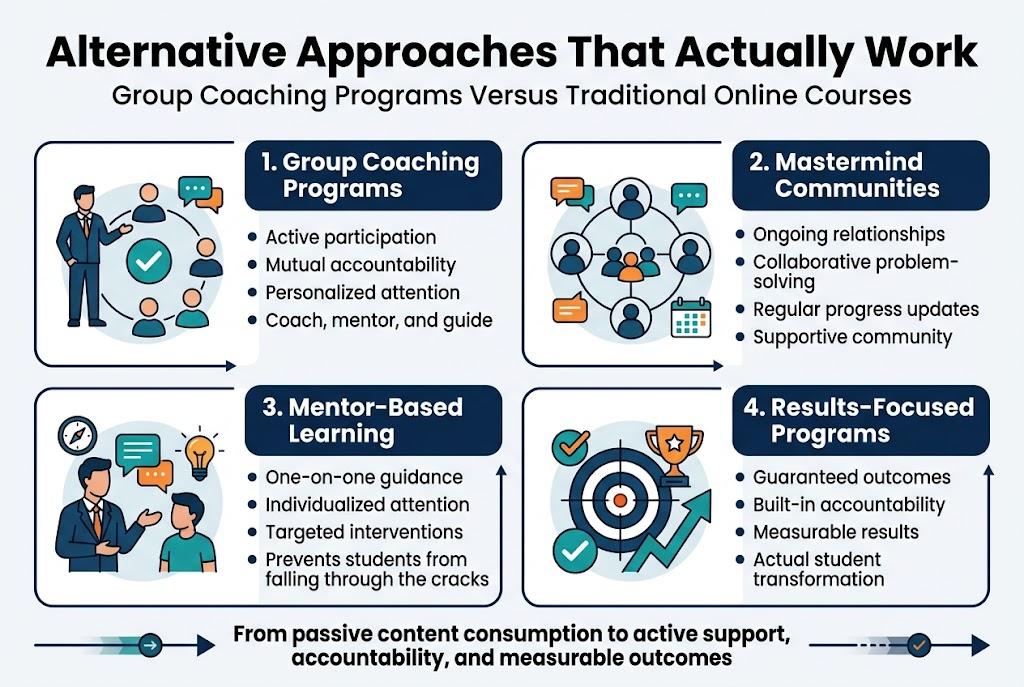
Group Coaching Programs Versus Traditional Online Courses
Now that we have covered the fundamental problems with traditional online courses, it’s time to explore more effective alternatives. Group coaching programs represent a revolutionary departure from the passive consumption model that characterizes most online courses. Unlike traditional formats where students watch videos in isolation, group coaching creates an environment of active participation and mutual accountability.
The key distinction lies in the transformation of the educator’s role. Instead of being merely a teacher delivering content, the facilitator becomes a coach, mentor, and guide who provides personalized attention to each participant. This shift ensures that students receive the specific support they need to overcome individual challenges and achieve their predetermined results.
Group coaching programs excel because they combine the benefits of personalized attention with the motivational power of peer accountability. When students know they’ll be checking in with both their coach and fellow participants, the likelihood of follow-through increases dramatically.
Mastermind Communities for Sustained Learning
Previously, I’ve mentioned the importance of community in learning success. Online mastermind communities, facilitated by platforms like Skool, offer a structured environment that promotes sustained learning and accountability. These communities create a framework where members support each other’s growth while maintaining focus on specific outcomes.
The mastermind model differs significantly from traditional course forums or comment sections. Instead of sporadic interactions, these communities foster ongoing relationships and collaborative problem-solving. Members commit to regular participation, sharing progress updates, and providing valuable feedback to peers.
This structured approach ensures that learning doesn’t stop when the initial content is consumed. Instead, it creates an ongoing cycle of application, reflection, and refinement that leads to lasting transformation.
Mentor-Based Learning for Personalized Guidance
With this in mind, mentor-based learning represents another powerful alternative that addresses the personalization gap in traditional online education. This approach recognizes that every student has unique circumstances, learning styles, and obstacles that require individualized attention.
The mentor’s role extends beyond content delivery to include fostering student greatness through personalized guidance. This one-on-one or small-group approach allows mentors to identify specific areas where students struggle and provide targeted interventions. The relationship becomes collaborative, with mentors adapting their approach based on each student’s progress and needs.
This personalized guidance creates a safety net that prevents students from falling through the cracks, a common occurrence in traditional online courses where individual struggles often go unnoticed and unaddressed.
Results-Focused Programs That Guarantee Outcomes
Next, we’ll examine how results-focused programs fundamentally reshape the learning experience by guaranteeing outcomes rather than simply providing access to information. These programs are designed with a laser focus on helping students achieve highly desirable, measurable results.
The structure of these programs incorporates built-in accountability mechanisms and high-consequence motivation that drive completion. Unlike traditional courses that measure success by content consumption, results-focused programs evaluate effectiveness based on actual student outcomes and transformations.
This approach creates a powerful psychological shift where both the provider and student are invested in achieving specific results. The program structure, accountability systems, and ongoing support all work together to ensure that students not only complete the program but achieve the promised transformation that motivated their initial enrollment.
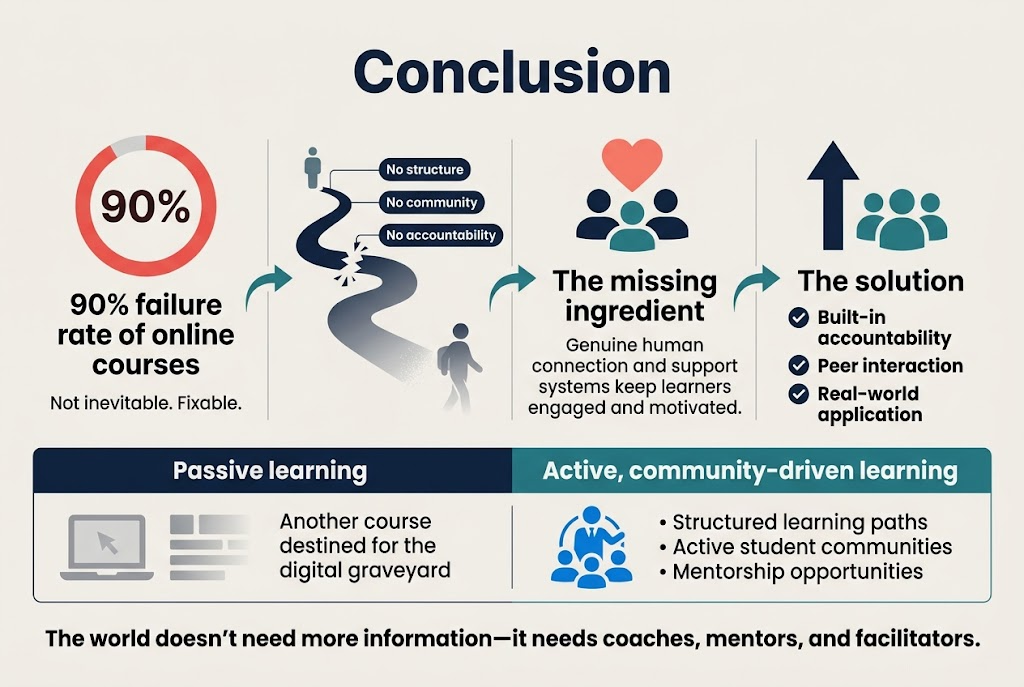
The staggering 90% failure rate of online courses isn’t inevitable—it’s fixable. When courses lack structure, community, and accountability, students inevitably drift away despite their initial enthusiasm. The missing ingredient isn’t more content or flashier presentations; it’s genuine human connection and support systems that keep learners engaged and motivated throughout their journey.
The solution lies in shifting from passive learning models to active, community-driven approaches. Instead of creating another course destined for the digital graveyard, focus on building programs with built-in accountability, peer interaction, and real-world application. Whether you’re a course creator or a learner, prioritize platforms and programs that offer structured learning paths, active student communities, and mentorship opportunities. The world doesn’t need more information—it needs coaches, mentors, and facilitators who can guide people to actually achieve their goals and transform their lives.
ExoWatts
Great content! Keep up the good work!
enoch.njobati@posteo.de
Thanks so much