

Currently Empty: CFA0.00



Blog
How to Land a $100K Remote Job in 2026 (Step-by-Step)

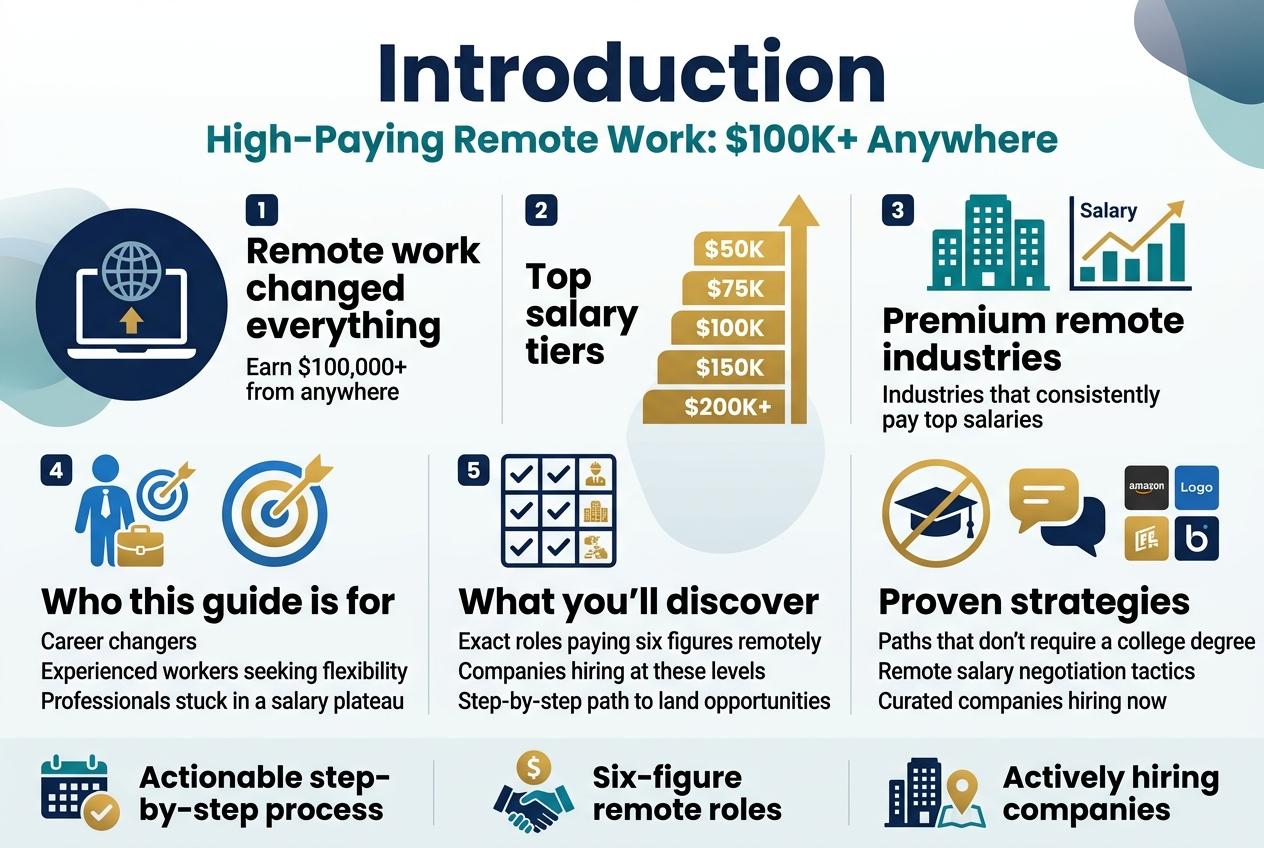
Remote work changed everything about career potential. You can now earn $100,000+ from anywhere—but only if you know where to look and how to position yourself.
This guide is for ambitious professionals ready to break into high-paying remote work, whether you’re a career changer, experienced worker seeking flexibility, or someone stuck in a salary plateau. You’ll discover the exact roles paying six figures remotely, which companies actually hire at these levels, and the step-by-step process to land these opportunities.
We’ll cover the top-paying remote job categories by salary tier ($50K to $200K+), reveal which industries consistently pay premium salaries for remote work, and share proven strategies for landing high-paying remote positions—including paths that don’t require a college degree. You’ll also get actionable salary negotiation tactics specific to remote roles and a curated list of companies actively hiring for these positions right now.
How to Land a $100K Remote Job in 2026
Understanding High-Paying Remote Job Salary Tiers
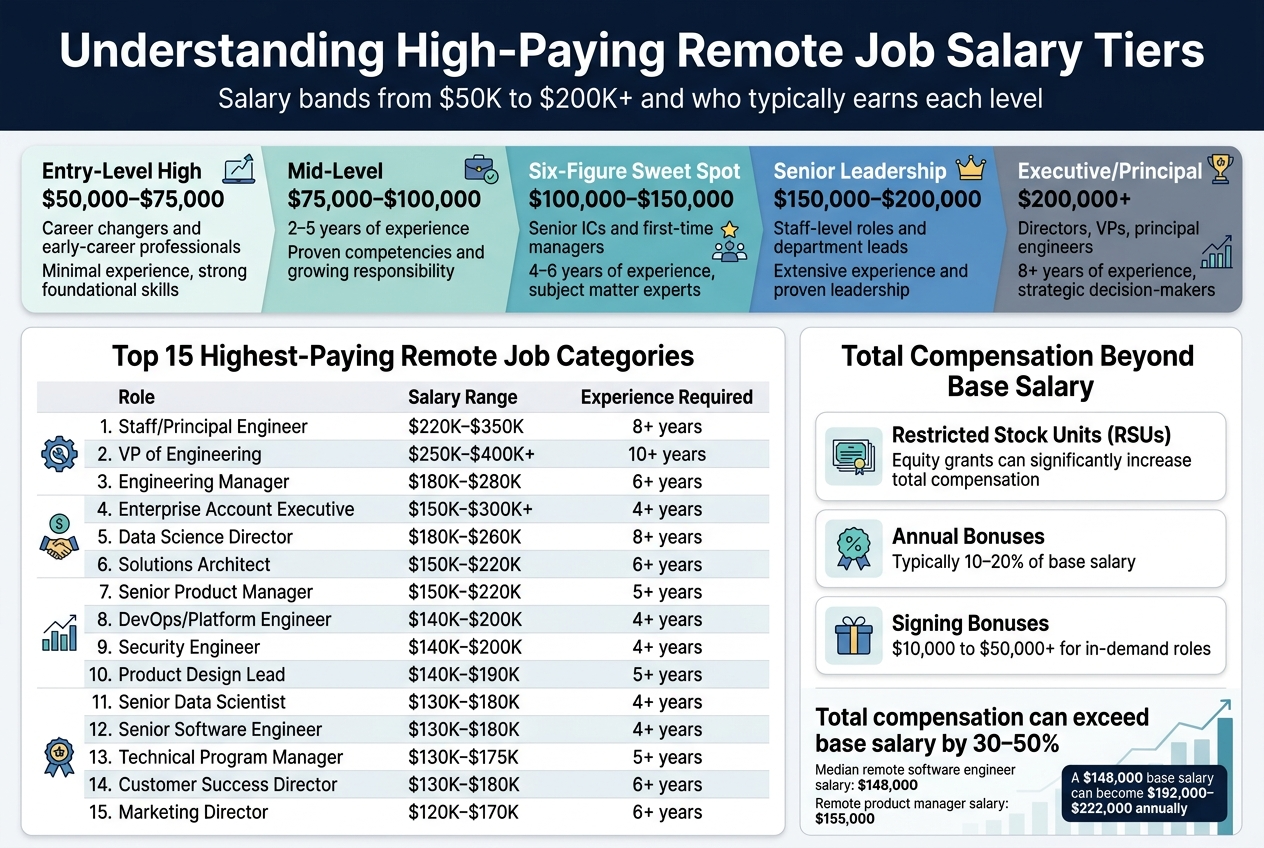
Salary bands from $50K to $200K+ and who typically earns each level
The remote job market operates across distinct salary tiers, each targeting professionals at different career stages and experience levels. Understanding these bands helps position yourself strategically for the right opportunities.
Entry-Level High ($50,000–$75,000) positions target career changers and early-career professionals who are transitioning into remote work or starting their professional journey. These roles typically require minimal experience but demonstrate strong foundational skills and learning potential.
Mid-Level ($75,000–$100,000) roles are designed for professionals with 2-5 years of experience who have proven their competencies and are ready to take on more responsibility. This tier represents the stepping stone toward six-figure compensation.
Six-Figure Sweet Spot ($100,000–$150,000) encompasses Senior Individual Contributors (ICs) and first-time managers who have developed specialized expertise in their field. These professionals typically have 4-6 years of experience and are recognized subject matter experts.
Senior Leadership ($150,000–$200,000) includes Staff-level roles and department leads who manage teams or critical technical initiatives. These positions require extensive experience and proven leadership capabilities.
Executive/Principal ($200,000+) represents the highest tier, including Directors, VPs, and principal engineers with 8+ years of experience who drive strategic decisions and organizational growth.
Top 15 highest-paying remote job categories with experience requirements
The most lucrative remote opportunities span across technology, sales, and leadership roles, with compensation varying significantly based on experience and specialization.
| Role | Salary Range | Experience Required |
|---|---|---|
| Staff/Principal Engineer | $220K–$350K | 8+ years |
| VP of Engineering | $250K–$400K+ | 10+ years |
| Engineering Manager | $180K–$280K | 6+ years |
| Enterprise Account Executive | $150K–$300K+ | 4+ years |
| Data Science Director | $180K–$260K | 8+ years |
| Solutions Architect | $150K–$220K | 6+ years |
| Senior Product Manager | $150K–$220K | 5+ years |
| DevOps/Platform Engineer | $140K–$200K | 4+ years |
| Security Engineer | $140K–$200K | 4+ years |
| Product Design Lead | $140K–$190K | 5+ years |
| Senior Data Scientist | $130K–$180K | 4+ years |
| Senior Software Engineer | $130K–$180K | 4+ years |
| Technical Program Manager | $130K–$175K | 5+ years |
| Customer Success Director | $130K–$180K | 6+ years |
| Marketing Director | $120K–$170K | 6+ years |
These roles demonstrate that technical expertise, leadership responsibilities, and revenue-generating capabilities command premium compensation in the remote marketplace.
Total compensation packages beyond base salary (equity, bonuses, benefits)
Now that we’ve covered the base salary structures, it’s essential to understand that total compensation extends far beyond the annual salary figure. Well-funded startups and public tech companies structure comprehensive packages that can significantly increase your actual earnings.
Restricted Stock Units (RSUs) represent a major component of compensation at established tech companies. These equity grants can substantially boost total compensation, particularly as companies grow and stock values appreciate.
Annual bonuses typically range from 10-20% of base salary, rewarding performance and company achievements. These bonuses are often tied to individual performance metrics and company-wide objectives.
Signing bonuses provide immediate financial incentives, ranging from $10,000 to $50,000+ for in-demand roles. These one-time payments help companies compete for top talent and offset any losses from leaving previous employers.
The impact of total compensation is significant—median remote software engineer salaries average around $148,000, while remote product managers earn approximately $155,000. However, total compensation at top-tier companies can push these figures 30-50% higher due to equity and bonus structures. This means a software engineer with a $148,000 base salary could realistically earn $192,000-$222,000 annually when factoring in complete compensation packages.
Remote Jobs by Compensation Level
$200K+ Executive and Principal Level Positions
These elite remote positions demand deep technical expertise or significant leadership experience, typically requiring 8-15+ years of proven track record. Principal and Staff Engineers at companies like GitLab, Coinbase, and Stripe represent the pinnacle of technical achievement, with median total compensation reaching $350,000+ and some positions exceeding $500,000. VP and Director-level leaders, Senior Solutions Architects, and top-performing Enterprise Account Executives also command these premium salaries. Success at this level requires demonstrated strategic impact and the ability to drive organizational transformation.
$150K-$200K Senior Leadership Roles
Now that we’ve covered the highest compensation tier, this band serves experienced professionals with specialized expertise or proven management capabilities. Senior Software Engineers, Engineering Managers, Senior Product Managers, Customer Success Directors, Enterprise Account Executives with commission structures, and Senior Data Scientists typically fall within this range. Remote Senior Product Managers average $211,699 in total compensation, while remote Engineering Managers average $195,000. Success at this level is driven by measurable impact, strategic influence, and demonstrated team effectiveness.
$100K-$150K Six-Figure Sweet Spot Opportunities
With this in mind, six-figure remote opportunities extend well beyond software engineering into sales, customer success, marketing, and operations. Mid-level Software Engineers earn $120K–$150K, while Product Managers command $110K–$145K. SaaS Account Executives can reach $100K–$180K OTE (On-Target Earnings), and Data Scientists typically earn $110K–$140K. Customer Success Managers ($90K–$130K), Marketing Managers ($90K–$120K), and Technical Writers ($90K–$130K) round out this tier. B2B SaaS companies typically pay 15-30% premiums for these roles compared to other industries.
$75K-$100K Building Toward Six Figures Positions
Previously established as a realistic starting point for career changers entering tech-adjacent fields, this range targets experienced professionals beyond entry-level. Junior to Mid-level Software Developers earn $80K–$100K, while Customer Success Managers command $70K–$95K. Technical Support Engineers ($75K–$95K), Digital Marketing Specialists ($70K–$90K), Recruiting Coordinators ($65K–$85K), and Project Managers ($75K–$95K) provide diverse pathways into high-paying remote work. Industry choice and continuous skill development prove crucial for advancement within this compensation tier.
$50K-$75K Entry Points to Remote Work
These positions serve as strategic entry points for career changers, parents returning to work, and recent graduates seeking remote opportunities. Customer Support Specialists start at $40K–$55K with clear paths to Customer Success Manager roles. Virtual Assistants earn $45K–$60K with advancement opportunities to Executive Assistant positions. Junior Data Analysts ($55K–$70K) can progress to Data Scientist roles, while Content Writers ($50K–$70K) advance to Content Strategist positions. Sales Development Representatives earn $50K–$70K OTE with paths to Account Executive roles, and Recruiting Coordinators ($50K–$65K) can advance to Technical Recruiter positions. Starting at $55K in customer support can lead to $100K+ in customer success within 3-5 years.
Industries That Pay Premium Salaries for Remote Work
Technology and software companies leading compensation
Technology stands as the unquestionable leader in remote work compensation, consistently offering the most lucrative opportunities for skilled professionals. Software engineering positions alone command impressive salaries ranging from $100K to $350K+, making them among the most sought-after remote roles in the market. The sector’s commitment to remote-first policies has created a competitive landscape where companies prioritize talent regardless of geographical location.
Product management roles follow closely behind, offering compensation packages between $110K and $220K annually. These positions require strategic thinking and cross-functional collaboration, making them ideal for remote work environments. Data science and machine learning engineering positions command even higher premiums, typically ranging from $120K to $250K, reflecting the high demand for analytical expertise in today’s data-driven economy.
DevOps and platform engineering professionals can expect salaries between $130K and $200K, while security engineering specialists often see the highest compensation within tech, earning between $140K and $220K. Companies like GitLab, Zapier, and Automattic have set industry standards by offering competitive compensation packages that remain consistent regardless of employee location, eliminating geographical pay disparities that traditionally existed in the workplace.
Finance and fintech sector opportunities
Previously, I’ve highlighted how technology dominates remote compensation, but the fintech revolution has created equally compelling opportunities within financial services. This sector offers substantial premiums due to the specialized regulatory knowledge required and the sensitive nature of financial data handling.
Quantitative analysts represent the pinnacle of fintech compensation, with salaries ranging from $150K to $300K annually. These roles combine mathematical expertise with financial acumen, making them highly valuable in remote settings. Compliance managers, essential for navigating complex regulatory environments, typically earn between $100K and $150K, while financial data scientists command salaries from $130K to $200K.
Leading fintech companies such as Stripe, Plaid, and Robinhood have embraced remote work models, recognizing that top financial talent can operate effectively from anywhere. The industry’s digital-first nature makes it particularly well-suited for remote operations, creating sustainable career paths with exceptional earning potential.
Healthcare non-clinical remote positions
With this in mind, next, we’ll see how healthcare extends beyond traditional clinical settings to offer substantial remote opportunities. Remote nursing positions in specialized areas like utilization review, case management, and telehealth typically provide compensation ranging from $70,000 to $100,000+, offering clinical professionals flexibility without sacrificing earning potential.
Non-clinical healthcare roles present even more lucrative opportunities, with positions in healthcare IT, medical coding, and health informatics often exceeding $80,000 annually. These roles leverage healthcare expertise while operating entirely in digital environments, making them perfect for remote work arrangements.
Sales roles with high earning potential
Now that we have covered traditional salary-based roles, sales positions offer unique earning potential through commission-based structures that can significantly amplify total compensation. Sales Development Representatives (SDRs) typically start with base salaries of $50K to $65K, but their On-Target Earnings (OTE) reach $70K to $90K with proper performance.
Mid-Market Account Executives command base salaries between $80K and $100K, with OTE ranging from $150K to $200K. Enterprise Account Executives represent the highest tier, earning base salaries of $120K to $150K with OTE potential between $250K and $350K+. Sales Managers bridge leadership and individual contribution, typically earning $100K to $140K base salaries with OTE ranging from $180K to $250K.
Top-performing enterprise sales professionals frequently exceed $300,000 in total compensation, though this comes with high-pressure quota expectations and inherent income variability based on performance and market conditions.
Landing High-Paying Remote Jobs Without a College Degree
Skill-based roles where portfolios trump credentials
Many high-paying remote roles prioritize demonstrated skills over formal credentials, where a strong portfolio often trumps a degree. The landscape has shifted dramatically in recent years, with companies increasingly focusing on what candidates can actually do rather than where they studied. Software Development, Tech/SaaS Sales, Customer Success, Technical Writing, and Digital Marketing represent prime examples of roles earning $80K–$150K+ without requiring a degree.
According to LinkedIn’s 2024 report, 45% of U.S. job postings no longer require a four-year degree, up from 35% in 2019. This trend reflects employers’ growing recognition that practical skills and proven results often matter more than academic credentials. Companies are discovering that candidates with strong portfolios and real-world experience frequently outperform those with traditional educational backgrounds but limited hands-on expertise.
Breaking into tech through bootcamps and self-teaching
Self-taught developers and bootcamp graduates can break into tech, landing $100K+ roles with strategic preparation and portfolio development. Some bootcamp alumni have successfully placed at companies paying $120K+, demonstrating that intensive, practical training programs can provide viable pathways into lucrative tech careers.
The key lies in choosing the right learning approach and dedicating sufficient time to building demonstrable skills. Bootcamps offer structured learning environments with industry-relevant curricula, while self-teaching provides flexibility to focus on specific technologies and personal interests. Both paths require dedication and consistent practice to develop the competencies that employers value most.
Sales and customer success career progression paths
Sales (Tech/SaaS) and Customer Success offer career progression paths based on aptitude and industry expertise rather than degrees. These fields reward performance, relationship-building skills, and deep understanding of customer needs over academic achievements. Top Sales Development Representatives (SDRs) can promote to Account Executive roles within 18-24 months, reaching $150K+ OTE (On-Target Earnings).
The progression typically follows a clear trajectory: starting as an SDR to learn the fundamentals, advancing to Account Executive to manage larger deals, and potentially moving into senior sales roles or customer success leadership positions. Success in these roles depends on communication skills, persistence, and the ability to understand complex business challenges.
Building proof of work to demonstrate competency
Building proof of work through personal projects, freelance work, or open-source contributions is critical for demonstrating competency without traditional credentials. Three months of documented project work can outweigh four years of unrelated coursework, especially when targeting startups that prioritize practical skills and innovative thinking.
Effective proof of work should showcase problem-solving abilities, technical proficiency, and real-world impact. This might include developing applications that solve actual problems, contributing to open-source projects, completing freelance assignments, or creating content that demonstrates expertise. The key is documenting the process, challenges overcome, and results achieved to provide tangible evidence of capabilities to potential employers.
Career Transition Strategies for High-Paying Remote Work
Realistic timelines from entry-level to six figures
The fastest realistic path from no relevant experience to $100K+ is 2-3 years through strategic career positioning. Two primary pathways have proven most effective: sales development roles leading to account executive positions, and technical skill development through intensive bootcamp programs.
For sales-oriented professionals, the progression from Sales Development Representative to Account Executive typically spans 18-24 months with consistent performance. Technical professionals following the bootcamp-to-developer route can expect a similar 2-3 year timeline to reach mid-level engineering positions with six-figure compensation.
Fast-track paths through sales development roles
Sales Development Representative positions offer one of the most accessible entry points into high-earning remote careers. Starting salaries typically range from $50K–$70K On-Target Earnings (OTE), providing immediate income while building essential sales skills.
The promotion pathway is clearly defined: consistent SDR performance leads to Account Executive roles within 18-24 months. Account Executives command significantly higher compensation, with $150K+ OTE becoming standard. For those targeting enterprise sales segments, total compensation can exceed $150K+ OTE within the 2-3 year timeframe.
This progression path requires minimal upfront investment beyond learning sales methodologies and developing strong communication skills, making it particularly attractive for career changers seeking rapid income growth.
Customer support to customer success progression
Previously, I’ve outlined how technical and sales roles provide fast-track opportunities, but customer-facing roles offer another viable pathway. Customer Support positions serve as an excellent foundation, typically starting at $40K–$55K annually while providing crucial exposure to customer relationship management.
The natural progression leads to Customer Success Manager roles, where professionals can earn $70K–$100K within 2-3 years of experience. This pathway leverages relationship-building skills developed in support roles while transitioning to more strategic customer retention and growth responsibilities.
Technical skill development for career changers
With this in mind, next, we’ll examine how technical bootcamps create accelerated pathways into high-paying development roles. These intensive 3-6 month programs provide focused skill development in programming languages, frameworks, and development practices.
Bootcamp graduates typically secure entry-level developer positions ranging from $65K–$90K, establishing a strong foundation for career growth. The technical learning curve is steep but manageable, with mid-level engineer positions offering $130K+ compensation achievable within 2-3 years of consistent skill development and project experience.
This pathway requires significant upfront time investment during the bootcamp phase but offers substantial long-term earning potential in the growing technology sector.
Step-by-Step Process to Secure High-Paying Remote Positions
Identifying your target salary tier and realistic goals
Setting specific compensation targets is crucial for a successful remote job search. Rather than vague aspirations, define precise goals such as reaching $120K within 18 months by transitioning from customer support to customer success at a B2B SaaS company. This level of specificity helps create a roadmap for skill development and career progression.
Begin by reviewing salary tiers to understand where you currently fit and where you want to be in 12-24 months. Research compensation ranges for your target roles across different company types and industries. This assessment will help you identify realistic stepping stones and the skills gaps you need to address to reach your desired tier.
Building relevant skills for high-demand remote roles
Now that we’ve established your salary goals, focus on developing skills that are frequently found in $100K+ remote positions. Technical proficiency in SQL and data analysis has become increasingly valuable across various roles, from marketing to operations.
Modern collaboration tools represent another critical skill area. Proficiency with platforms like Notion for documentation, Linear for project management, and Figma for design collaboration demonstrates your ability to work effectively in distributed teams. These tools are standard in high-paying remote environments.
Strong written communication skills cannot be overstated in remote work. Your ability to articulate ideas clearly through text directly impacts your effectiveness and perceived value. Additionally, developing expertise in project and program management frameworks positions you for leadership roles that command higher salaries.
Industry-specific knowledge also commands premium compensation. Whether it’s understanding SaaS metrics like ARR and churn rates or healthcare regulations for compliance roles, specialized expertise significantly increases your market value.
Targeting companies with strong remote compensation
With this foundation in mind, next, we’ll examine how not all remote jobs offer equal compensation. Understanding company types and their typical salary structures helps you focus your efforts strategically.
| Company Type | Salary Premium | Trade-offs |
|---|---|---|
| FAANG/Big Tech | Highest base + equity | Competitive hiring, longer processes |
| Well-funded Startups | High cash + significant equity | Higher risk, faster pace |
| Mid-size Tech | Competitive base, moderate equity | Balanced growth and stability |
| Traditional Companies | Market rate, limited equity | Slower adoption of remote practices |
| Early-stage Startups | Lower cash, high equity potential | High risk, resource constraints |
Focus your applications on companies that have demonstrated commitment to remote work through their compensation structure and policies. Companies that pay location-agnostic salaries typically offer better opportunities for high earnings.
Optimizing applications for remote hiring processes
Remote positions receive 3-5x more applications than traditional roles, making optimization critical for standing out. Your application materials must demonstrate remote work competency from the first interaction.
Craft tailored cover letters that specifically address remote work challenges and your solutions. Include a portfolio or work samples that showcase your ability to deliver results independently. This tangible evidence of your capabilities helps hiring managers visualize your potential contribution.
Demonstrate remote work competency through examples of asynchronous communication and self-management. Use results-focused resume bullets with specific metrics that quantify your achievements. For instance, “Increased team productivity by 40% through implementation of async workflow protocols” shows both technical skill and measurable impact.
Prepare thoroughly for async interview components like written exercises, which are common in remote hiring processes. These assessments evaluate your ability to communicate complex ideas in writing and work independently on challenging problems – core requirements for high-paying remote roles.
Salary Negotiation Tactics for Remote Positions
Researching Market Rates Using Multiple Data Sources
Establishing your true market value is the foundation of any successful salary negotiation. Leverage multiple data sources to build a comprehensive understanding of compensation ranges. Levels.fyi provides exceptional insight into tech roles with total compensation breakdowns, while Glassdoor offers broad coverage across industries. For anonymous tech salary sharing, Blind delivers real-world compensation data from actual employees. Payscale serves as an excellent resource for non-tech roles and traditional industries.
The power of thorough research cannot be overstated—candidates who negotiate typically receive 7-10% higher starting salaries compared to those who accept initial offers. Cross-reference data across these platforms to identify compensation patterns and avoid outliers that might skew your expectations.
Timing Negotiations for Maximum Leverage
Strategic timing transforms average negotiations into successful outcomes. The optimal window for salary discussions occurs after receiving a written offer but before signing any agreements. This position maximizes your leverage as the company’s chosen candidate while maintaining professional momentum.
Avoid premature negotiations during initial screening calls or before completing final interview rounds. Your negotiating power increases exponentially once you become the selected candidate, as companies have already invested significant time and resources in the hiring process and are motivated to close the deal.
Negotiating Remote-Specific Benefits Beyond Base Salary
Remote work opens unique negotiation opportunities beyond traditional salary discussions. Consider requesting a signing bonus to offset any immediate transition costs or equity refreshers to enhance long-term compensation potential. A home office budget ranging from $1,000 to $5,000 can cover essential equipment and ergonomic furniture.
Monthly stipends add substantial value over time—negotiate for internet and phone allowances between $100-$200 monthly, or coworking space allowances ranging from $200-$500 monthly for flexible workspace options. Professional development budgets support continuous learning, while annual home office refresh budgets ensure your workspace remains current and productive.
Understanding Location-Based Pay Policies
Company location policies significantly impact your total compensation package. Research whether prospective employers adjust salaries based on your geographic location or maintain standardized pay regardless of residence. Some organizations offer location-neutral compensation, while others implement regional adjustments that could affect your earning potential.
Analyze total compensation structures carefully, as lower base salaries might be offset by substantial equity packages or enhanced benefits. Understanding these policies upfront prevents surprises and enables more informed negotiation strategies tailored to each company’s compensation philosophy.
Top Companies and Resources for High-Paying Remote Jobs
Companies consistently hiring remote talent at competitive salaries
Now that we’ve covered the essential strategies for landing high-paying remote positions, let’s examine the companies that consistently offer premium compensation for remote talent. Several industry leaders have established themselves as reliable sources of high-paying remote opportunities.
Technology giants lead the compensation landscape. GitLab offers remote positions ranging from $120K to $350K, while Stripe provides even higher compensation brackets from $150K to $400K. Coinbase matches this premium tier with salaries spanning $150K to $350K. These companies have built their entire operations around remote-first principles, making them ideal targets for job seekers.
Productivity and design platforms also offer substantial compensation packages. Zapier provides remote roles between $100K and $250K, while Figma offers positions ranging from $140K to $300K. Notion falls within the $130K to $280K range, and Shopify provides opportunities from $120K to $280K. These companies understand the value of distributed talent and compensate accordingly.
Enterprise software companies round out the top-tier options. Datadog offers remote positions from $120K to $250K, HubSpot provides opportunities ranging from $80K to $200K, and Automattic offers roles between $100K and $200K. These companies have proven track records of supporting remote employees with competitive packages.
Identifying truly remote-first versus remote-friendly employers
Previously, I’ve emphasized the importance of targeting the right companies, but distinguishing between truly remote-first and merely remote-friendly employers is crucial for securing the best opportunities and compensation packages.
Remote-first companies integrate distributed work as a core organizational value. These companies design their processes, culture, and communication systems specifically for remote teams. When evaluating potential employers, examine their company values pages and mission statements for explicit mentions of remote work as a foundational principle.
Job posting analysis provides immediate insights into a company’s remote commitment. Look for specific location requirements that indicate genuine remote-first policies. Postings mentioning “US Remote,” “Anywhere,” or “Global Remote” typically signal companies with mature remote work infrastructures. These employers have invested in the systems and processes necessary to support distributed teams effectively.
Remote-friendly companies, in contrast, may offer remote work as an accommodation rather than a strategic advantage. These organizations often maintain headquarters-centric cultures where remote employees may face subtle disadvantages in career advancement or compensation discussions.
Using salary research tools and job platforms effectively
With this in mind, next, we’ll explore the essential tools and platforms that enable effective salary research and job discovery in the remote work landscape.
Comprehensive salary research platforms provide the foundation for informed negotiation strategies. Levels.fyi offers detailed compensation data specifically for technology roles, including base salary, equity, and bonus breakdowns. Glassdoor provides broader industry coverage with employee-submitted salary information and company reviews. Blind offers anonymous discussions about compensation and workplace culture, while Payscale delivers personalized salary reports based on experience and location factors.
Strategic platform utilization involves exploring remote jobs organized by salary tiers to identify opportunities matching your compensation targets. Focus on platforms that allow filtering by salary ranges, enabling you to concentrate on positions meeting your $100K+ objectives.
AI-powered job matching represents the cutting edge of remote job discovery. These tools analyze your experience, skills, and salary goals to surface relevant opportunities that might otherwise remain hidden in traditional job boards. This technology becomes particularly valuable when targeting specific compensation levels while maintaining flexibility in role types and industries.
How to start today with useful urls
Job Search Platforms for $100K+ Remote Roles
FlexJobs (https://flexjobs.com) remains the gold standard for legitimate remote work, with positions starting at $75K and climbing well into six figures. Their premium membership ($14.95/month) filters out scams and showcases verified opportunities from Fortune 500 companies.
Remote.co (https://remote.co) features a dedicated high-salary section where you’ll find engineering, product management, and executive roles regularly exceeding $100K. Their daily email alerts save hours of searching.
AngelList (https://angel.co) connects you directly with funded startups offering equity packages alongside competitive salaries. Many remote positions here start at $120K+ for experienced professionals.
We Work Remotely (https://weworkremotely.com) hosts the largest remote job board globally, with programming, design, and marketing roles frequently hitting six-figure compensation.
Professional Development Resources
Coursera for Business (https://coursera.org/business) offers certificates from Google, IBM, and Meta that employers recognize. Their data science and cloud computing programs directly translate to $100K+ remote opportunities.
LinkedIn Learning (https://linkedin.com/learning) provides industry-recognized courses while building your professional network. Complete relevant certifications and add them to your LinkedIn profile immediately.
GitHub (https://github.com) serves as your coding portfolio for tech roles. Contribute to open-source projects and showcase your skills through repositories that demonstrate real-world problem-solving abilities.
Networking and Direct Application Channels
LinkedIn Premium (https://linkedin.com/premium) unlocks InMail credits for reaching hiring managers directly. Search for remote companies using keywords like “distributed team” or “remote-first culture.”
Twitter/X follows for remote work advocates like @gitlabremote, @remoteyear, and @buffer provide insider tips and job announcements before they hit traditional boards.
AngelList Talent (https://angel.co/talent) lets you set salary expectations upfront, ensuring you only connect with companies meeting your $100K+ requirement.
Company Research Tools
Glassdoor (https://glassdoor.com) reveals actual salary ranges and interview experiences. Filter by “remote” and sort by salary to identify top-paying employers.
Built In (https://builtin.com) showcases tech company cultures and salary transparency reports. Their remote company directories highlight organizations known for competitive compensation.
Crunchbase (https://crunchbase.com) helps you identify well-funded startups likely to offer premium salaries for remote talent. Recent Series B and C companies often have budget flexibility for top candidates.
The remote job market has fundamentally transformed, offering legitimate six-figure opportunities across industries, experience levels, and educational backgrounds. From entry-level positions at $50K that can grow to $100K+ within 2-3 years, to executive roles exceeding $350K, high-paying remote work is no longer exclusive to senior engineers at tech giants. The key differentiators are strategic targeting—focusing on well-funded startups and tech companies that pay 20-40% more than traditional industries—and positioning yourself with in-demand skills like data analysis, modern collaboration tools, and strong written communication.
Success in landing these roles comes down to execution: identifying your realistic salary tier, building relevant skills through portfolios and certifications, and targeting companies with genuine remote-first cultures like GitLab, Zapier, and Stripe. Whether you’re a career changer, returning parent, or professional without a traditional degree, proven paths exist to reach $100K+ through sales progression, customer success transitions, or skills-based fields like software development. The opportunity is real and available now—the question isn’t whether high-paying remote jobs exist, but whether you’re ready to strategically pursue them.