

Currently Empty: CFA0.00



Blog
How to earn 200k with Freelancing With No Experience in 2026

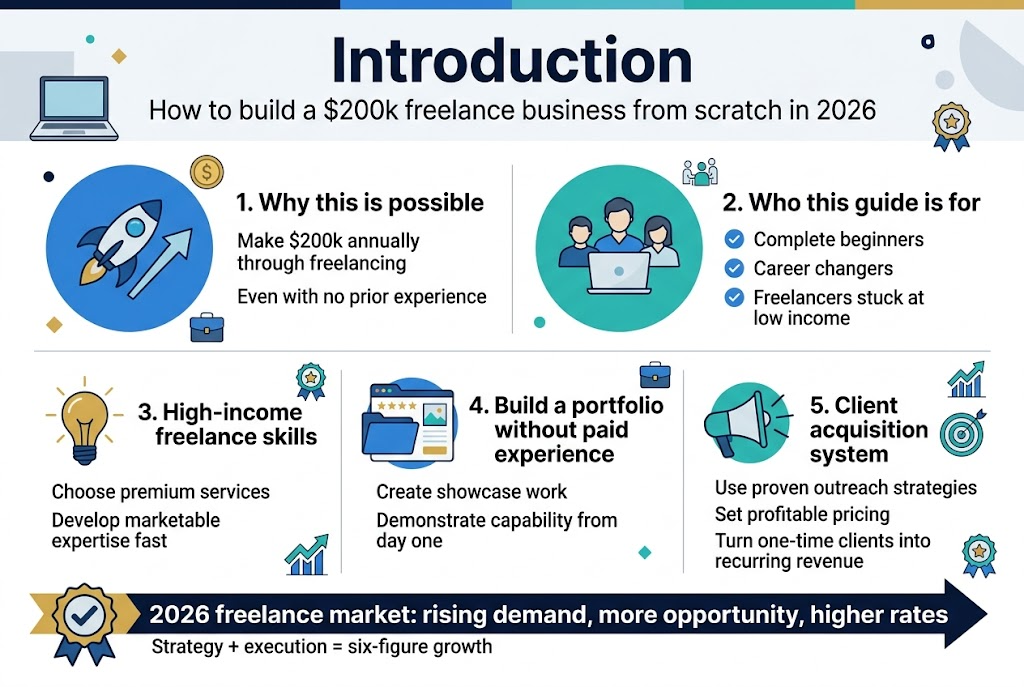
Making $200k annually through freelancing without prior experience might sound impossible, but it’s absolutely achievable with the right strategy and execution. This comprehensive guide is designed for complete beginners, career changers, and anyone ready to build a profitable freelance business from scratch in 2026.
Who this guide is for: People with zero freelance experience who want to break into high-paying remote work, professionals looking to transition from traditional employment to freelancing, and existing freelancers stuck at low income levels who need a systematic approach to scale up.
The freelance market in 2026 offers unprecedented opportunities for skilled professionals who know how to position themselves strategically. Companies are increasingly relying on freelancers for specialized projects, and the demand for quality services continues to outpace supply in many niches.
In this guide, we’ll walk through choosing high-income freelance skills that can realistically generate six-figure annual revenue, even if you’re starting from zero. You’ll discover exactly which services command premium rates and how to quickly develop marketable expertise without years of traditional experience.
We’ll also cover building a compelling portfolio without paid experience using proven methods that demonstrate your capabilities to potential clients. You’ll learn specific techniques for creating showcase work that wins contracts and establishes credibility from day one.
Finally, you’ll master setting up your client acquisition system – the foundation that separates successful freelancers earning $200k from those struggling to find their next project. This includes proven outreach strategies, pricing frameworks that maximize profitability, and systems for converting one-time clients into recurring revenue streams.
Ready to transform your earning potential? Let’s dive into the step-by-step roadmap that can take you from freelancing beginner to six-figure earner.
How to earn 200k with Freelancing With No Experience:
Choose Your High-Income Freelance Skill with clickable help links
Focus on One Marketable Service That Commands Premium Rates
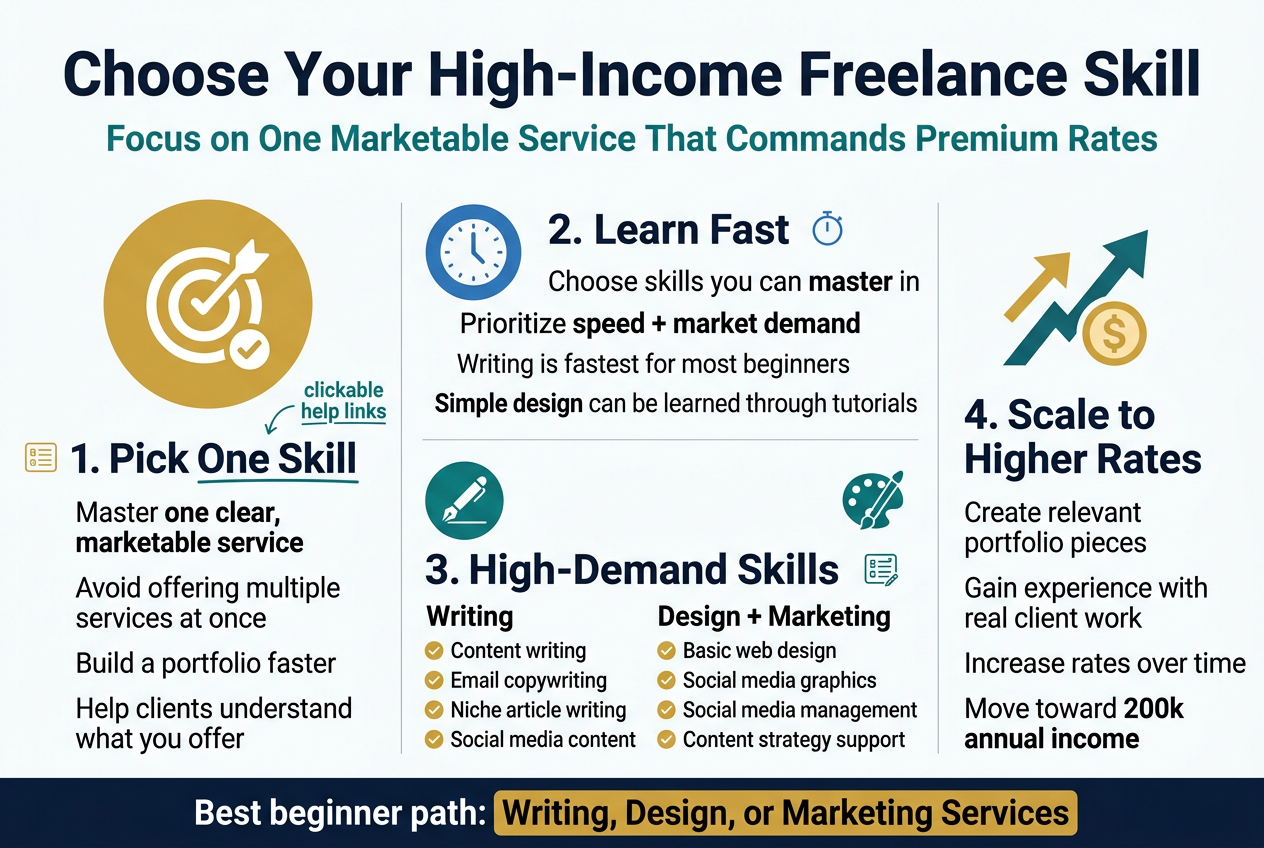
When learning how to earn 200k freelancing with no experience, the foundation begins with selecting one clear, marketable skill that you can sell effectively. Rather than attempting to offer multiple services simultaneously, concentrate your efforts on mastering a single high-income freelance skill that commands premium rates in today’s market.
Content writing stands out as one of the most accessible yet profitable options for beginners. This encompasses blog post writing, website copy, and various forms of written content that businesses desperately need. The beauty of focusing on one service lies in how it helps potential clients immediately understand what you offer, eliminating confusion and making their hiring decision easier.
By narrowing your focus to one specific skill, you can build relevant portfolio pieces much faster than if you were scattered across multiple disciplines. This concentrated approach accelerates your journey from beginner to professional, allowing you to command higher rates sooner.
Select Skills You Can Master Within Weeks, Not Years
Freelancing with no experience requires strategic skill selection based on learning speed and market demand. Prioritize skills that align with your natural strengths while being achievable within weeks rather than years of study.
Writing services offer the fastest path to proficiency for most beginners. Unlike complex technical skills that require extensive training, effective writing can be developed through focused practice and studying successful examples. Content writing, specifically, allows you to leverage existing knowledge while developing your craft through real client work.
Simple design work also falls into this category, particularly for those with visual aptitude. Basic web design elements, social media graphics, and marketing materials can be learned through online tutorials and practiced immediately.
Prioritize Writing, Design, or Marketing Services with Strong Demand

The demand for remote work and freelance services remains exceptionally strong, particularly in writing and content creation. This sustained demand creates abundant opportunities for newcomers to enter the market and build successful practices.
High income freelance skills in writing include several lucrative niches:
- Content writing for websites and blogs
- Email copywriting for marketing campaigns
- Niche article writing for specialized industries
- Social media content creation
Beyond writing, entry-level marketing tasks present excellent opportunities for beginners. These include social media management, basic market research, and content strategy support. These services are in constant demand as businesses recognize the importance of consistent online presence.
The key advantage of these service categories is their scalability. As you gain experience and confidence, you can gradually increase your rates and take on more complex projects, setting the foundation for reaching that 200k annual income goal through strategic growth and client development.
Build a Compelling Portfolio Without Paid Experience
How to earn 200k with Freelancing With No Experience:
Create 3-5 Professional Sample Pieces to Showcase Your Abilities
When building a freelance portfolio without experience, clients need to see tangible examples of your work quality. The key principle here is simple: clients hire work they can see, and you don’t need paid experience to prove your capabilities.
Start by creating 3-5 professional sample pieces that demonstrate your chosen high income freelance skills. For content writers, this might include three compelling blog posts, a web copy sample for a product page, and an email sequence demonstration. If you’re focusing on design work, create mockups for different industries or business types.
The hosting strategy is equally important for your freelance portfolio without experience. Set up a simple blog or create a free single-page website to showcase these samples professionally. This approach costs nothing but presents your work in a polished, accessible format that potential clients can easily review.
Develop Spec Projects for Real Businesses to Demonstrate Results

Now that we have covered creating basic samples, the next level involves developing spec projects for actual businesses. This strategy bridges the gap between theoretical work and real-world application, making your portfolio significantly more compelling.
Choose a small business or local nonprofit as your target for spec work. Create a sample piece that addresses a genuine business challenge, but clearly label it as “spec” or “sample” work. This transparency maintains professional integrity while showcasing your problem-solving abilities.
For example, you might create a spec project showing a blog revamp for a local bakery. This demonstrates your ability to understand business needs, apply your skills to real scenarios, and deliver practical solutions that businesses actually need.
Include Mini Case Studies Showing Your Problem-Solving Process
With this foundation in place, elevate your portfolio by including mini case studies that showcase your analytical thinking and process-oriented approach. These case studies become powerful tools for demonstrating how you approach challenges and deliver value.
Structure your mini case study to show the complete journey: present the “before” situation, explain your work and methodology, and outline the expected results. For instance, document how you “rewrote homepage headline; improved clarity; expected better conversions.” This format proves you understand business outcomes, not just creative output.
This case study approach transforms simple portfolio pieces into compelling business arguments for your services. It shows potential clients that you think strategically about their challenges and can articulate the value you bring to their business growth.
Set Up Your Client Acquisition System
Develop a Clear One-Sentence Pitch That Attracts High-Value Clients
Your one-sentence pitch serves as the foundation of your freelance client acquisition system. This concise statement must clearly communicate what you do and specifically who you help. A well-crafted pitch eliminates confusion and immediately positions you as a specialist rather than a generalist.
The most effective pitches follow a simple formula: “I’m a [your skill] who [specific service] for [target audience].” For example, “I’m a writer who creates SEO blog posts for small SaaS businesses” instantly tells prospects your expertise, deliverable, and ideal client. This level of specificity helps potential clients understand whether you’re the right fit for their needs.
When developing your pitch, focus on a narrow niche rather than trying to appeal to everyone. High-value clients prefer specialists who understand their industry’s unique challenges. Your pitch should reflect this specialized knowledge and create immediate recognition among your target market.
Create Professional Marketing Assets and Portfolio Pages
Now that you have your pitch refined, the next step in your freelance client acquisition system involves creating compelling marketing materials. Your portfolio page serves as the primary tool for demonstrating your capabilities to potential clients, even without extensive paid experience.
Build a concise portfolio page or PDF that showcases three strong samples of your work. These samples should directly relate to the services mentioned in your one-sentence pitch and demonstrate your ability to deliver results for your target audience. Quality trumps quantity – three exceptional pieces will make a stronger impression than ten mediocre ones.
Include a short bio on your portfolio page that reinforces your primary skill and clearly states who you serve. This bio should align perfectly with your one-sentence pitch, creating consistency across all your marketing materials. Remember that clarity is more important than having a polished agency brand when you’re starting your freelance business management journey.
Your portfolio page should be easily accessible and shareable, whether it’s a simple website page or a well-designed PDF document. The goal is to provide prospects with immediate proof of your capabilities while reinforcing your positioning as a specialist in your chosen field.
Prepare Email Outreach Templates for Consistent Lead Generation
With your pitch and portfolio ready, establishing a systematic approach to email outreach becomes crucial for consistent freelance client acquisition. Prepare email outreach templates that incorporate your one-sentence pitch and can be customized for different prospects while maintaining your core message.
Your outreach templates should include a brief introduction that features your pitch, a concise explanation of how your services specifically benefit their type of business, and a clear call-to-action. Keep these templates short and focused – busy prospects appreciate brevity and directness.
Develop variations of your templates for different scenarios: cold outreach to new prospects, follow-up emails for non-responders, and relationship-building messages for warm leads. Having these templates prepared ensures you can maintain consistent communication without starting from scratch each time.
Your short pitch should be easily adaptable for various communication channels beyond email, including social media messages, networking conversations, and proposal submissions. This consistency across all touchpoints strengthens your brand recognition and helps prospects remember your specific value proposition as you work toward earning higher income through strategic freelance positioning.
Master Multiple Client-Finding Strategies
Leverage Freelance Platforms for Initial Credibility and Income
Freelance platforms like Upwork serve as your launching pad for establishing credibility and generating your first income streams. These marketplaces provide the foundation for how to earn 200k freelancing, even when you’re starting with no experience. The key lies in optimizing your profile around your chosen skill to attract quality clients who value expertise over experience.
Focus on creating a comprehensive profile that showcases your specific abilities rather than trying to appeal to everyone. Highlight the high income freelance skills you’ve developed and demonstrate your understanding of client needs through your profile description. Use relevant keywords that clients search for, and ensure your portfolio samples align perfectly with your target market’s requirements.
These platforms offer built-in payment protection, client review systems, and project management tools that help you deliver professional results from day one. The rating system becomes your initial social proof, allowing you to build a reputation that translates into higher-paying opportunities over time.
Use Direct Outreach to Land Higher-Paying Private Clients
Now that we have covered platform-based strategies, direct outreach becomes your pathway to significantly higher earnings through freelance client acquisition. This approach involves proactively reaching out to small businesses via email and social media to identify those with inconsistent content or specific problems you can solve.
The strategy centers on offering specific fixes rather than generic services. Research potential clients thoroughly, identify gaps in their current approach, and present tailored solutions that address their exact pain points. This targeted method demonstrates your expertise while positioning you as a problem-solver rather than just another service provider.
Aim to send 10-20 personalized messages per week to maintain consistent pipeline growth. Each message should reference specific issues you’ve observed in their current setup and propose concrete improvements. This volume ensures steady lead generation while keeping the outreach manageable and maintaining quality standards.
Direct outreach typically commands premium rates because you’re approaching clients directly rather than competing in crowded marketplace environments. Private clients often have larger budgets and value the personalized attention that comes with direct relationships.
Build Social Proof Through Content Marketing and Networking

With this in mind, building social proof through strategic content marketing amplifies your visibility and attracts clients organically. Post short articles on LinkedIn or maintain a professional blog to demonstrate your expertise in your chosen field. This content serves as both a portfolio showcase and a client attraction mechanism.
Focus on creating valuable insights that address common industry challenges or share practical tips that your target audience can immediately implement. This approach positions you as a thought leader while providing potential clients with tangible examples of your knowledge and problem-solving abilities.
Joining freelancers’ communities through Slack, Discord, and Facebook groups creates multiple networking opportunities for support, referrals, and accessing second-hand job opportunities. These communities often share projects that members can’t take on due to capacity constraints or skill mismatches, creating a steady stream of potential opportunities.
Active participation in these communities builds relationships that extend beyond simple job referrals. Fellow freelancers become sources of industry insights, collaboration opportunities, and professional development resources that support your journey toward recurring revenue freelancing and business scaling goals.
The combination of consistent content creation and strategic networking creates a compounding effect where your reputation grows organically, reducing your dependence on active client hunting while increasing your ability to command premium rates.
Price Your Services for Maximum Profitability
Set Competitive Entry Rates That Allow for Quick Scaling
Now that you’ve established your freelancing foundations, implementing effective freelance pricing strategies becomes crucial for building momentum. Starting with competitive entry rates positions you for rapid client acquisition while maintaining profitability. For beginners entering the freelancing market, establishing rates between $25-$75 per short blog post (300-500 words) provides an excellent entry point that attracts clients while demonstrating your value proposition.
As you develop your skills and client relationships, scaling to $75-$200 per long-form article (800-1,500 words) becomes achievable through consistent delivery and quality improvements. This pricing structure allows you to compete effectively while building the experience necessary for higher-tier projects that contribute to how to earn 200k freelancing goals.
Structure Payment Terms to Ensure Cash Flow Security
With competitive rates established, structuring payment terms strategically protects your financial stability throughout project cycles. For larger projects, requesting 50% upfront creates essential cash flow security while reducing client risk and demonstrating mutual commitment to project success.
Utilizing reliable payment platforms such as PayPal, Stripe, or direct bank transfers ensures consistent payment processing and professional transaction handling. These platforms provide tracking capabilities, automated invoicing, and secure payment processing that supports your growing freelance business operations.
Implement Value-Based Pricing as You Gain Experience
Previously establishing competitive entry rates, transitioning to value-based pricing becomes possible after delivering solid results and collecting client testimonials. This progression represents the natural evolution from hourly or project-based pricing to outcome-focused pricing models that reflect the true value you provide to clients.
Raising rates systematically after demonstrating consistent results allows you to move beyond commodity pricing toward premium service positioning. Value-based pricing aligns your compensation with client outcomes rather than time invested, creating opportunities for significant income increases that support your journey toward earning substantial freelancing income.
This pricing evolution requires documenting success metrics, client feedback, and measurable results that justify higher rates and position you as a strategic partner rather than a service provider.
Convert One-Time Projects into Recurring Revenue
Overdeliver on First Assignments to Build Client Loyalty
Building lasting client relationships starts with exceeding expectations from your very first project. When you consistently overdeliver on initial assignments, you establish yourself as a reliable freelancer who goes above and beyond standard expectations. This strategy is particularly crucial for achieving recurring revenue freelancing success.
The key to overdelivering lies in subtle yet impactful gestures that demonstrate your commitment to client success. Deliver your work early whenever possible, as this immediately sets you apart from freelancers who barely meet deadlines. Additionally, include improvement suggestions that showcase your strategic thinking and genuine interest in the client’s business growth.
These small but significant actions create a powerful first impression that translates into client loyalty. When clients see that you’re invested in their success beyond just completing the assigned task, they’re more likely to view you as a valuable partner rather than just another service provider.
Offer Retainer Packages for Predictable Monthly Income
Now that you’ve established trust through exceptional initial work, transitioning to retainer agreements becomes your pathway to sustainable income growth. Retainer packages transform your freelance business from unpredictable project-based work into a stable, recurring revenue model.
Present retainer options in simple, clear terms that emphasize value and consistency. For example, propose packages like “I can deliver 4 posts per month for $X” or similar structured offerings that align with your service area. This approach provides clients with predictable costs while securing you guaranteed monthly income.
The beauty of retainer agreements lies in their mutual benefit. Clients receive priority access to your services and consistent output, while you gain financial stability that allows for better business planning and scaling your freelance business operations.
Collect Testimonials and Referrals to Fuel Business Growth
With this foundation of satisfied clients in mind, systematically collecting testimonials and referrals becomes your growth engine. After completing each successful job, proactively ask for feedback and request one testimonial that highlights specific results or experiences.
Testimonials serve as powerful social proof that addresses potential clients’ concerns about working with freelancers, especially when building your reputation in competitive markets. These authentic endorsements become invaluable assets for your marketing efforts and client acquisition strategies.
Equally important are referrals from satisfied clients, as repeat clients and referrals are fundamental drivers of business growth. Word-of-mouth recommendations carry significantly more weight than cold outreach efforts, often resulting in higher-quality leads who are pre-qualified and more likely to convert into long-term clients.
Scale Your Operations for 200k Annual Income
Systematize Your Workflows and Client Management Processes
Now that you’ve established your client base, creating systematized workflows becomes crucial for scaling your freelance business to reach that 200k annual income target. The foundation of efficient scaling lies in developing reusable systems that eliminate repetitive tasks and streamline your operations.
Start by creating standardized content briefs that you can quickly customize for different clients. These templates should include project scope, deliverables, timelines, and communication protocols. This approach ensures consistency across all your projects while dramatically reducing the time spent on project setup.
Develop standard proposals that can be adapted for various client needs. Having a proven proposal structure allows you to respond to opportunities quickly while maintaining professionalism. Include sections for project understanding, your approach, timeline, and pricing structure that can be easily modified based on specific requirements.
Simple invoicing systems are essential as your client list grows. Implement automated invoicing software that can track project milestones, send payment reminders, and maintain financial records. This systematization prevents cash flow issues and reduces administrative overhead that could otherwise consume valuable billable hours.
Dedicate 5-10 Hours Weekly to Business Development Activities
With your operational systems in place, consistent business development becomes the engine for scaling your freelance business. Allocating 5-10 hours weekly to business development activities ensures continuous growth and helps you reach that high income freelance goal.
This time commitment should be divided between learning new skills and implementing growth strategies. The learning component keeps you competitive in rapidly evolving markets, while implementation activities directly contribute to client acquisition and revenue growth.
Your minimum commitment should never fall below 3 hours per week, even during busy periods. This baseline ensures you maintain momentum in business development while managing existing client work. During lighter periods, increase this to the full 10 hours to accelerate growth.
Focus your business development time on activities that directly impact lead generation: refining your service offerings, optimizing your online presence, networking with potential clients, and improving your sales processes. Track the effectiveness of different activities to optimize your time allocation.
Implement a 6-Month Timeline for Reaching Consistent Lead Generation
Successfully scaling your freelance operations requires a structured timeline approach that builds systematically toward consistent lead generation. This 6-month framework provides a clear roadmap for achieving sustainable growth.
Month 1-2: Setup Phase marks your foundation-building period. During these initial months, focus on learning proven lead generation strategies, practicing campaign creation, and establishing the fundamental systems needed for client acquisition. This phase involves setting up your digital presence, creating marketing materials, and developing your service positioning.
Month 3-4: First Campaigns represents your market entry phase. Launch your initial marketing campaigns, begin generating leads, and start booking discovery calls with potential clients. This period typically yields your first client acquisitions as you refine your approach based on real market feedback. Expect some trial and error as you optimize your messaging and targeting.
Month 5-6: System Working is when your efforts begin producing consistent results. Your lead generation system should be reliably producing 3-10 qualified leads per week, and you’ll be closing clients with increasing predictability. This phase demonstrates that your freelance client acquisition strategies are working effectively.
Month 7+: Scaling begins once your system is consistently generating qualified leads. Focus on scaling successful strategies to generate as many clients as needed to reach your $200k annual income target. This phase involves optimizing conversion rates, increasing lead volume, and potentially raising your pricing as demand grows.
Manage Your Freelance Business Like a Professional
Use Essential Tools for Time Tracking, Invoicing, and Communication
To scale your freelance business to 200k annually, you need professional systems that eliminate administrative chaos. Time tracking tools are absolutely critical for hourly jobs, as they provide transparent documentation of work performed and justify your billing to clients. Popular options include Toggl, Clockify, or Harvest, which automatically generate detailed reports showing exactly how you’ve allocated time across different projects.
Professional invoicing software ensures you get paid promptly and maintain cash flow. Tools like FreshBooks, Wave, or QuickBooks Self-Employed streamline the billing process with automated reminders, recurring invoice capabilities, and payment tracking. These platforms integrate seamlessly with payment processors, allowing clients to pay via credit card or bank transfer with minimal friction.
Communication management becomes paramount when juggling multiple high-value clients. Establish dedicated channels for each project using Slack workspaces, Microsoft Teams, or professional email systems. Create standardized email and proposal templates that maintain consistency while saving hours of writing time. These templates should include project scopes, deliverables, timelines, and terms of service.
A free website builder or portfolio host like WordPress.com, Wix, or GitHub Pages establishes your professional presence without significant upfront investment. This digital foundation supports your credibility when potential clients research your background before committing to higher-budget projects.
Maintain a Monthly Marketing Budget of Around $150
Now that we have covered the operational tools, let’s examine the financial investment required for sustainable client acquisition. A modest monthly marketing budget of $150 represents a strategic investment in your freelance business growth rather than an unnecessary expense. This budget allocation demonstrates professional commitment while remaining accessible for beginners building their freelance empire.
This marketing budget should focus primarily on initial outreach efforts that generate the highest return on investment. Consider allocating funds toward premium LinkedIn subscriptions that unlock advanced search capabilities and InMail credits for direct client contact. Paid social media advertising on platforms where your target clients congregate can amplify your visibility beyond organic reach limitations.
Professional headshots, updated portfolio imagery, or small design investments in marketing materials also fall within this budget range. These visual assets significantly impact first impressions when potential clients evaluate your professionalism against competitors. The key principle involves treating this $150 as an investment that should generate returns exceeding the monthly expenditure.
Track every dollar spent within this budget against measurable outcomes like consultation requests, proposal invitations, or actual client conversions. This data-driven approach ensures your marketing investments contribute directly toward your path to earning 200k through freelancing.
Track Client Acquisition Costs and Optimize for Under $100 Per Client
With this marketing framework established, monitoring client acquisition costs becomes essential for long-term profitability. Client acquisition cost (CAC) represents the total investment required to convert a prospect into a paying client, including marketing expenses, time investment, and any tools or resources used during the sales process.
Calculate your CAC by dividing total marketing and sales expenses by the number of new clients acquired during a specific timeframe. For sustainable freelance business growth, aim to optimize these costs for under $100 per client in the long term. This target ensures that your investment in acquiring new business remains proportional to the revenue potential each client represents.
High-value freelance clients typically generate significantly more than $100 in initial project value, making this acquisition cost threshold highly profitable. For instance, if you’re targeting clients with project budgets exceeding $2,000, a $100 acquisition cost represents just 5% of the initial engagement value, leaving substantial room for profit margins.
Continuously analyze which marketing channels and outreach strategies produce the lowest acquisition costs while maintaining client quality standards. Email campaigns might cost $20 per conversion while networking events could require $75 per client acquired. This granular tracking enables you to double down on the most cost-effective strategies while eliminating wasteful spending that doesn’t contribute to your 200k income goal.
Start now with clickable help links
Essential Resources to Launch Your 200k Freelance Journey
Getting started with freelancing can feel overwhelming, but having the right tools and resources makes all the difference. These carefully selected platforms will help you start freelancing 2026 with confidence and set you on the path to earning substantial income.
Free Portfolio Building Tools:
- Behance (for creative work)
- GitHub (for developers)
- Contently (for writers)
- Figma (for design portfolios)
Client Acquisition Platforms:
- Upwork and Fiverr for beginners
- LinkedIn Sales Navigator for direct outreach
- AngelList for startup clients
- Dribbble for design projects
Step-by-Step Action Plan for Week One
Your first week determines everything. Here’s exactly what you need to do to start freelancing with no experience and begin building toward that 200k goal.
Day 1-2: Choose your high income freelance skills using the skill assessment tools mentioned in section 1. Don’t overthink this – pick something that matches your interests and market demand.
Day 3-4: Create your first portfolio pieces using the strategies from section 2. Even without paid experience, you can create compelling work samples that attract clients.
Day 5-7: Set up your profiles on at least three client platforms and send your first five proposals.
Time Investment Calculator
| Weekly Hours | Monthly Income Potential | Annual Projection |
|---|---|---|
| 10-15 hours | $1,500-$3,000 | $18,000-$36,000 |
| 20-30 hours | $4,000-$8,000 | $48,000-$96,000 |
| 40+ hours | $10,000-$20,000+ | $120,000-$240,000+ |
Quick-Start Resource Library
Email Templates: Ready-to-use client outreach templates that get responses
Proposal Scripts: Proven formulas for winning project proposals
Contract Templates: Legal agreements that protect your business
Invoice Systems: Professional billing solutions that ensure timely payments
Pricing Calculators: Tools to determine your optimal rates based on market research and skill level
The key to reaching that 200k milestone isn’t just hard work – it’s working smart with the right systems from day one. These resources eliminate the guesswork and give you a proven roadmap that thousands of successful freelancers have already followed.
Start with just one platform, master it completely, then expand. Your freelance business management skills will develop naturally as you gain experience, but having these foundational tools ensures you’re building on solid ground from the very beginning.
The journey to earning $200k through freelancing without experience is entirely achievable when you follow a systematic approach. By choosing a high-income skill, building a compelling portfolio through spec projects, mastering client acquisition strategies, and pricing your services strategically, you create the foundation for a thriving freelance business. The key is transforming your approach from a “rollercoaster of luck” to a scalable system with predictable growth, allowing you to focus on high-paying projects while turning away clients that don’t align with your goals.
Success requires patience and consistency—most freelancers see their first clients within 3-4 months and have a fully dialed-in system by month 6. With a modest time commitment of 5-10 hours per week and a marketing budget of around $150 monthly, you can build a client acquisition system that generates multiple qualified leads weekly. Start today by choosing your skill, creating three portfolio pieces, and sending your first outreach messages. The sooner you begin implementing these proven strategies, the faster you’ll be on your way to building a six-figure freelancing business that provides both financial freedom and professional fulfillment.