

Currently Empty: CFA0.00



Blog
How to Build a $100K SEO Business in 2026 (Step-by-Step)

How to Build a $100K SEO Business in 2026
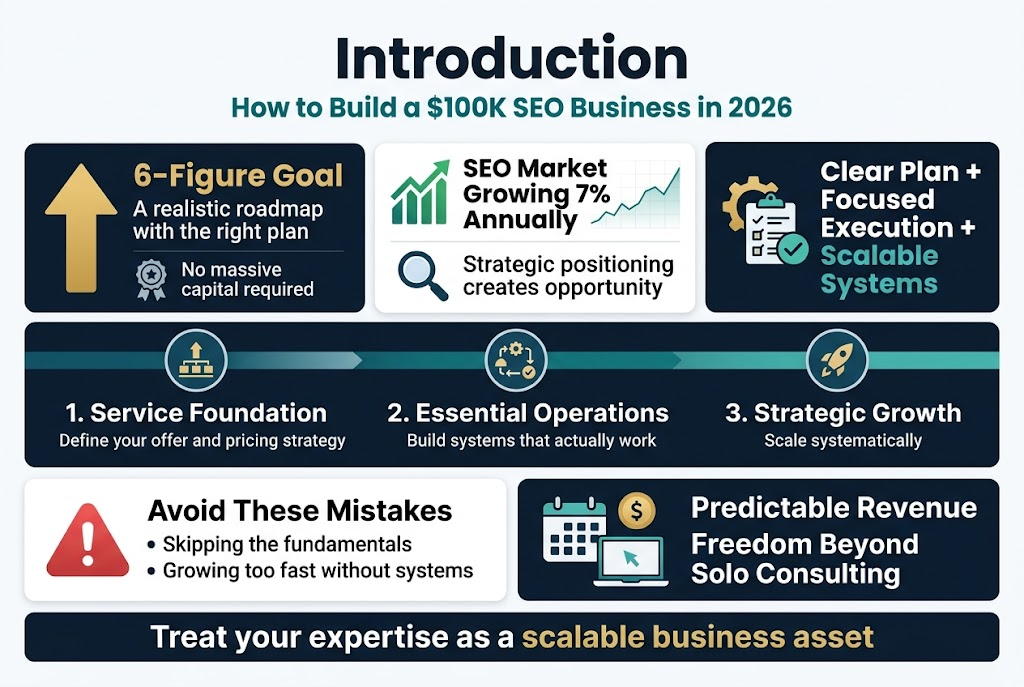
Building a six-figure SEO business isn’t just a pipe dream—it’s a realistic goal with the right roadmap. This guide is for experienced SEO professionals, freelancers hitting income ceilings, and entrepreneurs ready to scale beyond solo consulting work.
The SEO services market continues growing at 7% annually, creating opportunities for agencies that position themselves strategically. You don’t need massive upfront capital or years of corporate experience. You need a clear plan, focused execution, and the willingness to treat your expertise as a scalable business asset.
This step-by-step guide covers everything from laying your foundation to reaching that $100K milestone. We’ll walk through how to build a $100K SEO business in 2026 by focusing on three critical areas: establishing your service foundation and pricing strategy, building essential operations that actually work, and scaling systematically through strategic growth tactics.
Most agencies fail because they skip the fundamentals or try to grow too fast without proper systems. We’ll show you how to avoid those pitfalls and create a business that generates predictable revenue while giving you the freedom you started this journey to find.
Plan Your SEO Agency Foundation
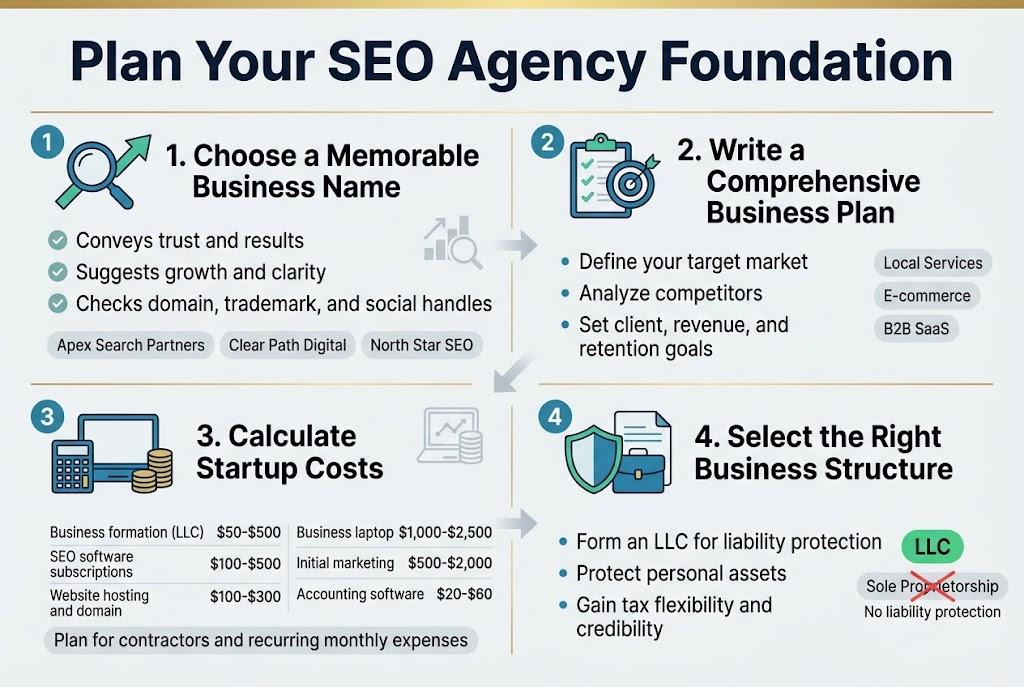
Choose a memorable business name that conveys trust and results
Your SEO agency’s name serves as the first impression for potential clients and sets the tone for your entire brand identity. An effective SEO agency name should immediately convey trust, precision, and measurable results to your target audience. Words that suggest growth, clarity, and upward movement tend to resonate particularly well with business owners seeking digital marketing solutions.
When brainstorming potential names, consider examples like Apex Search Partners, Clear Path Digital, and North Star SEO, which effectively communicate expertise and results-driven approaches. These names incorporate powerful imagery that suggests reaching peak performance and providing clear direction for clients’ online visibility.
Before finalizing your choice, you’ll need to verify that your desired name is available as a web domain, as your website will be central to your marketing efforts. Additionally, search federal trademark databases to ensure your chosen name doesn’t infringe on existing intellectual property, which could lead to costly legal issues down the road. Securing matching social media handles across platforms maintains brand consistency and prevents competitors from claiming similar usernames that could confuse your audience.
Write a comprehensive business plan defining your target market
Creating a comprehensive business plan forces you to clarify exactly who you will serve and how you will deliver measurable results. This foundational document must define your target market and identify the specific industries your company will focus on, whether that’s local service businesses, e-commerce companies, or B2B software firms.
A thorough competitor analysis should be included to help identify market gaps and opportunities for differentiation. Research existing SEO agencies in your area or niche to understand their pricing structures, service offerings, and client testimonials. This analysis will reveal underserved segments or service gaps you can exploit.
Your business plan should outline specific operational goals, such as determining the exact number of clients needed to break even financially. Include detailed projections for client acquisition timelines, average contract values, and retention rates. This strategic planning ensures you have a clear roadmap for growth rather than operating on intuition alone.
Calculate startup costs and financial projections for break-even
One significant advantage of starting an SEO agency is that it requires very little upfront capital compared to traditional businesses. The primary expenses involve legal formation fees, essential software subscriptions, and initial marketing efforts to attract your first clients.
Your startup cost breakdown should include:
| Expense Category | Cost Range |
|---|---|
| Business formation (LLC) | $50-$500 |
| SEO software subscriptions | $100-$500 |
| Website hosting and domain | $100-$300 |
| Business laptop | $1,000-$2,500 |
| Initial marketing | $500-$2,000 |
| Accounting software | $20-$60 |
You may also need to budget for freelance writers or technical contractors as you begin taking on clients and need additional capacity. Your financial projections should forecast ongoing expenses like software subscriptions, contractor fees, and projected monthly recurring revenue based on realistic client acquisition goals.
Select the right business structure for liability protection
Most new SEO agencies should form as a Limited Liability Company (LLC) for optimal protection and flexibility. An LLC creates a crucial legal boundary that protects the business’s finances from your personal bank accounts, ensuring your personal property remains generally protected if the agency faces a lawsuit or significant debt.
This business structure adds a layer of professional credibility that clients appreciate when evaluating potential SEO partners. Additionally, LLCs offer valuable tax flexibility, allowing you to choose how the business income is taxed based on your specific situation.
In contrast, operating as a sole proprietorship offers zero liability protection, making it an impractical choice for entrepreneurs building a serious client-facing agency. The LLC structure positions your business professionally while safeguarding your personal assets as you grow your client base and revenue.
Define Your Service Offerings and Pricing Strategy
Specialize in a specific niche for better results and reputation
Successful agency owners understand that deciding exactly what services they will offer is crucial for long-term success. Specializing in a specific area of search marketing often leads to better client results and a stronger industry reputation, making subsequent marketing efforts more effective. Rather than attempting to serve every possible market, focus your expertise on a particular vertical or business type.
Some agencies focus exclusively on B2B software companies, diving deep into the unique challenges of SaaS marketing, technical product positioning, and enterprise sales cycles. Others specialize in local service businesses, mastering the intricacies of local search rankings, Google Business Profile optimization, and location-based marketing strategies. This focused approach allows you to develop specialized knowledge, create industry-specific case studies, and command premium pricing for your expertise.
Create core service packages including technical audits and content strategy
Now that you’ve identified your niche, you’ll need to structure your service offerings around core categories that deliver measurable results. Operators typically choose from several essential service categories to build their foundational packages.
Technical SEO Audits form the backbone of most agencies, involving comprehensive analysis of a website’s code and structure to identify optimization opportunities. On-Page Optimization focuses on updating individual page content, title tags, and meta descriptions to improve search visibility. Content Strategy development creates targeted articles and web copy that align with search intent and business objectives.
Link Building services concentrate on acquiring high-quality backlinks to improve domain authority and search rankings. For agencies serving local businesses, Local SEO becomes essential, focusing on managing Google Business Profiles and optimizing for location-based searches. These core services provide the foundation for comprehensive SEO campaigns while allowing for specialized expertise development.
Establish monthly retainer pricing models for predictable revenue
With your service packages defined, implementing a solid pricing strategy ensures your agency remains profitable and sustainable. A monthly retainer model provides predictable recurring revenue for ongoing optimization work, creating financial stability that allows for better resource planning and team management.
This recurring revenue model works particularly well for continuous SEO activities like content creation, link building, and performance monitoring. The predictable income stream enables you to invest in better tools, hire skilled team members, and focus on delivering results rather than constantly seeking new projects.
Project-based pricing remains valuable for one-time tasks like comprehensive site audits or website migrations. These discrete projects can serve as entry points for new clients while generating immediate revenue to support cash flow needs.
Productize your services to eliminate custom project chaos
Previously, many agencies struggled with the complexity of custom projects that varied wildly in scope and deliverables. Productizing SEO services means turning these complex projects into clear, easy-to-sell packages that streamline your entire business operation.
This approach eliminates the endless back-and-forth negotiations typical of bespoke projects while giving clients complete clarity about what they’ll receive. Productized services make your offerings significantly easier to sell, as prospects can quickly understand the value proposition without extensive consultation calls.
The benefits extend beyond sales efficiency. Productized services attract high-ticket clients who appreciate transparency and professional packaging. They deliver predictable revenue streams that support business growth planning. Most importantly, this approach helps agencies break free from the operational chaos of custom projects, enabling faster scaling and more efficient resource allocation.
With this standardized approach, your team can develop specialized expertise in delivering specific packages, improving quality while reducing delivery time. This efficiency creates competitive advantages that compound over time, positioning your agency for sustainable growth toward the $100K milestone.
Handle Legal Requirements and Business Formation
Register Your Business Entity and Obtain Necessary Licenses
Previously, you’ve established your service offerings and pricing strategy. Now that we have covered the foundational planning elements, it’s crucial to formalize your SEO business through proper legal registration. Digital marketing firms must comply with general local and state business registration requirements to operate legally from day one.
The first step involves applying for a general business operating license through your city or county clerk’s office. This fundamental requirement ensures your agency meets basic regulatory standards and can legally conduct business activities within your jurisdiction. The specific requirements may vary depending on your location, so research the exact documentation and fees required in your area.
Securing the right licenses protects both your business and your clients, establishing credibility and demonstrating professionalism. Without proper licensing, you risk facing penalties, legal complications, or being unable to enforce contracts with clients. This legal foundation becomes increasingly important as you scale toward your $100K revenue goal.
Secure Trademark Protection and Domain Availability
With your business registration in progress, the next critical step involves protecting your brand identity. Before finalizing your business name, entrepreneurs must verify that their desired business name is available as a web domain. This digital real estate forms the cornerstone of your online presence and SEO expertise demonstration.
Equally important is conducting thorough research of federal trademark databases to ensure your chosen name doesn’t infringe on existing intellectual property. This preventive measure protects you from costly legal disputes and potential rebranding requirements down the road. The investment in proper trademark research pays dividends by securing your brand’s long-term viability.
Many states offer name reservation services, allowing business owners to reserve a name for a set period before formally registering the company. This option provides flexibility during the decision-making process while ensuring your preferred name remains available.
Set Up Proper Tax Compliance and Sales Tax Registration
Now that we’ve covered brand protection, let’s address the financial compliance requirements that will support your business operations. Depending on your state’s regulations, your SEO agency may need to register with the department of revenue to collect and remit applicable sales taxes.
Understanding your tax obligations from the outset prevents complications as your revenue grows toward the $100K milestone. Sales tax registration becomes particularly important when serving clients across different states, as tax requirements can vary significantly by jurisdiction. Proper compliance demonstrates professionalism and protects your business from potential audits or penalties.
File DBA Registration if Operating Under a Different Brand Name
With tax compliance addressed, the final legal requirement involves brand name registration. If your agency operates under a name different from its legal entity name, you’ll need to file a “Doing Business As” (DBA) registration.
The DBA registration serves multiple practical purposes beyond legal compliance. This filing allows your company to legally market itself under your chosen brand name, which is essential for building brand recognition and client trust. Additionally, the DBA enables you to open bank accounts under your business brand name, streamlining financial operations and maintaining professional separation between personal and business finances.
This legal foundation supports your scaling efforts by ensuring all business operations can be conducted under your marketing brand while maintaining proper legal structure.
Build Essential Business Operations
Set up project management systems for client deliverables
A smooth operational backend allows an agency to handle multiple clients without dropping tasks. Operators need a reliable system for tracking deliverables and communicating with accounts, utilizing software to assign tasks, set deadlines, and monitor campaign progress. This systematic approach prevents critical deliverables from falling through the cracks and ensures consistent service quality across all client accounts.
The key to effective project management lies in selecting software that enables clear task assignment and deadline monitoring. Your chosen platform should provide visibility into each campaign’s progress while facilitating seamless communication between team members and client accounts. This operational foundation becomes increasingly critical as your client roster expands and project complexity grows.
Create standardized client onboarding processes
Establishing workflows early prevents chaos as the client roster grows. This includes creating a standardized questionnaire to gather access credentials and business goals from new accounts. Setting up dedicated communication channels keeps clients informed and reduces unexpected phone calls.
A well-structured onboarding process creates consistency in how you collect essential information from each new client. Your standardized questionnaire should systematically capture website access details, analytics credentials, current marketing objectives, and specific business goals. This methodical approach ensures no critical information is overlooked during the initial client setup phase.
Dedicated communication channels serve as the foundation for professional client relationships. By establishing clear protocols for client communication from the outset, you create boundaries that protect your time while ensuring clients feel informed and supported throughout their engagement.
Implement performance reporting templates and KPI tracking
Build templates to show clients their monthly traffic growth and keyword ranking improvements, providing a professional experience. These standardized reports demonstrate tangible value while maintaining consistency in how you present results across all client accounts.
Performance reporting templates should focus on metrics that directly correlate with client business objectives. Monthly traffic growth data and keyword ranking improvements serve as concrete evidence of your SEO efforts’ effectiveness. These visual representations of progress help clients understand the value of your services and justify continued investment in your agency.
Consistent KPI tracking enables you to identify trends and optimization opportunities across different client campaigns. This data-driven approach positions your agency as results-focused and demonstrates your commitment to measurable outcomes.
Establish dedicated business banking and accounting software
Open a dedicated business bank account to separate agency income from personal funds. Connecting accounting software to the business bank account simplifies invoice generation and expense tracking. This financial separation creates clean accounting records while streamlining your business’s financial management processes.
A dedicated business banking setup provides the foundation for professional financial operations. This separation ensures clear distinction between personal and business transactions, which proves essential for tax preparation and financial reporting. The integration between your business bank account and accounting software automates much of the bookkeeping process, reducing manual data entry and potential errors.
Streamlined invoice generation and expense tracking capabilities enable you to maintain accurate financial records with minimal administrative overhead. This operational efficiency allows you to focus more time on client delivery and business growth rather than manual accounting tasks.
Develop Your Online Presence and Portfolio
Build a Professionally Optimized Agency Website as Your Primary Case Study
Your agency website functions as your most powerful marketing tool and serves as living proof of your SEO capabilities. This digital showcase must clearly articulate your specific services and target industries while demonstrating the exact best practices you promise to implement for clients. The website should feature a clean, professional design that reflects your expertise and attention to detail.
Technical excellence is non-negotiable for an SEO agency’s website. Fast loading speeds, mobile responsiveness, and technically sound site architecture form the foundation of credibility. Every element, from meta descriptions to internal linking structure, should exemplify the optimization techniques you’ll deliver to clients. This approach transforms your website into a powerful case study that prospects can evaluate in real-time.
Create Compelling Case Studies Showcasing Measurable SEO Results
Case studies serve as the cornerstone of your credibility, providing concrete evidence of your ability to improve search visibility for clients. These detailed showcases should highlight specific metrics such as organic traffic increases, keyword ranking improvements, and revenue growth attributable to your SEO strategies.
Even without established agency clients, you can demonstrate your expertise through alternative examples. Results from your own affiliate sites provide excellent proof of concept, showcasing your ability to rank websites in competitive niches. Previous in-house marketing roles also offer valuable case study material, allowing you to highlight successful SEO campaigns you’ve managed for employers.
Structure each case study with clear before-and-after metrics, timeline details, and specific strategies implemented. This transparency builds trust with potential clients while positioning you as a results-driven professional who understands the measurable impact of effective SEO.
Establish Strong LinkedIn Presence for Credibility and Thought Leadership
LinkedIn serves as your professional platform for building industry credibility and establishing thought leadership within the SEO community. Both your personal founder profile and company page require consistent attention and strategic content development.
Publishing insightful articles on current search trends demonstrates your deep understanding of the industry while keeping you visible to potential clients researching their options. These thought leadership pieces should address common SEO challenges, algorithm updates, and emerging trends that affect your target market.
Your LinkedIn presence becomes particularly valuable when prospects conduct due diligence on your agency. A well-maintained profile with regular, valuable content positions you as an authority figure who stays current with industry developments and can provide strategic guidance beyond basic optimization tasks.
Design Lead Capture Systems for Consultation Requests
Converting website visitors into potential clients requires strategically designed lead capture mechanisms that make it simple for prospects to engage with your services. Integration of clear, prominent lead capture forms throughout your website ensures visitors can easily request consultations or preliminary site audits.
These systems should be positioned at natural decision points in the user journey, such as after case study presentations or service descriptions. The forms should request essential information while minimizing friction that might prevent completion. Offering value, such as a complimentary site audit or SEO assessment, incentivizes prospects to provide their contact information and begin the sales conversation.
Scale to $100K Through Strategic Growth
Implement paid advertising funnels for automated lead generation
With your agency foundation established and operations running smoothly, the next crucial step involves creating sustainable lead generation systems. Paid advertising sales funnels serve as the backbone of automated lead generation, enabling your agency to generate qualified prospects on autopilot. These funnels work continuously in the background, supporting automated lead generation that fuels consistent agency growth without requiring constant manual intervention.
The key to successful paid advertising funnels lies in creating targeted campaigns that attract decision-makers actively seeking SEO services. By implementing well-structured funnels, you can systematically nurture prospects from initial awareness through to conversion, ensuring a steady pipeline of potential clients.
Focus on high-ticket clients through productized service packages
Now that your lead generation systems are in place, the focus shifts to attracting premium clients through strategic service positioning. Productizing SEO services emerges as a fundamental strategy for scaling an agency effectively. This approach transforms complex, custom projects into clear, easy-to-sell packages that attract high-ticket clients while delivering predictable revenue streams.
Productized services eliminate the uncertainty that often accompanies bespoke SEO projects. Instead of engaging in lengthy discovery phases and custom proposals, you present clients with well-defined packages that clearly outline deliverables, timelines, and expected outcomes. This clarity attracts high-ticket clients who value professionalism and prefer straightforward purchasing decisions.
The predictable revenue aspect of productized services cannot be overstated. When clients understand exactly what they’re purchasing and the associated costs, it becomes easier to forecast revenue and plan for growth. This predictability forms the foundation for scaling your agency to the $100K milestone.
Track critical KPIs to ensure service delivery and client retention
Previously established systems require constant monitoring to maintain effectiveness. Tracking critical Key Performance Indicators (KPIs) becomes essential to ensure that productized services deliver tangible value and help keep clients coming back. Without proper KPI tracking, agencies risk delivering subpar results that lead to client churn and damage to reputation.
Critical KPIs for productized SEO services should include organic traffic growth, keyword ranking improvements, conversion rate increases, and client satisfaction scores. These metrics provide clear evidence of value delivery and help identify areas where services may need adjustment or improvement.
Regular KPI monitoring also enables proactive client communication. When you can demonstrate consistent progress through concrete metrics, clients develop confidence in your services and are more likely to renew contracts or upgrade to higher-tier packages.
Build systems that reduce time-per-client while increasing value
With KPI tracking in place, the final scaling component involves operational efficiency. By productizing services, agencies can create streamlined offerings that eliminate the back-and-forth typically associated with bespoke projects. This systematic approach allows for the development of systems that reduce time-per-client while simultaneously increasing the value delivered.
Streamlined systems might include standardized reporting templates, automated progress updates, and systematized implementation processes. These efficiencies enable your team to serve more clients without proportionally increasing workload, directly contributing to revenue growth.
The combination of reduced time investment per client and increased value delivery creates a powerful scaling mechanism. As your systems become more efficient, profit margins improve while client satisfaction remains high, setting the stage for sustainable growth toward your $100K revenue target.
Building a successful $100K SEO agency in 2026 comes down to following a proven framework: establishing your foundation with clear service offerings and competitive pricing, handling the legal requirements properly, and building operational systems that can scale. The key differentiator is moving beyond custom projects toward productized services that eliminate the chaos of bespoke work while delivering consistent value to clients. This approach creates predictable revenue streams through monthly retainers ranging from $1,000 to $10,000, allowing you to focus on growth rather than constantly reinventing your processes.
The SEO services market continues growing at 7% annually, making this an opportune time to launch your agency. Success requires dedication to continuous learning, strong client management skills, and enough financial runway to cover expenses while building your initial client base. Remember that your own website serves as your most visible case study—make it a showcase of the results you promise to deliver for others. With the right foundation, operational systems, and strategic growth approach, reaching $100K in annual revenue within 6-18 months is an achievable goal for committed entrepreneurs ready to transform their SEO expertise into a thriving business.